Jim Knipfel (1965 – 2026)
Remembering the columnist, memoirist and novelist. Truthdig contributor Jim Knipfel at home in Brooklyn in 2011. (Kate Crane)
Truthdig lost a beloved contributor and friend last week when Jim Knipfel died at his home in Wisconsin following a yearlong illness. He was 61.
Jim was a celebrated memoirist, novelist and critic who published a column, “Slackjaw,” every week for 40 years. During the final years of his life, he covered a culture beat for this website that bore his easily identifiable fingerprints.
Jim wrote a lot about movies (“pictures” he usually called them) with an authority that increased the closer he got to the scrappy, the weird and the arcane. For Jim, the low-budget grotesque oddity and forgotten curio deserved as much consideration, and usually more, as any big-budget production. During “Oppenheimer’s” rollout in the summer of 2023, Jim wrote most of Truthdig’s history of nuclear cinema, and the following winter put together a list of Christmas films that are “just plain wrong,” including Jim’s favorite all-time holiday movie, K. Gordon Murray’s 1956 “Santa Claus vs. the Devil,” which he called a “thing of deranged wonder.”
He was a natural storyteller.
Jim was in full form in his definitive annotated obituary of B-movie director Roger Corman, and could speak for hours about the postwar production politics of Japanese monster movies. His unwritten but long-planned book about Godzilla is a “what-if” the world will have to live with. “I’ve never seen ‘Titanic,’ but have seen Edgar G. Ulmer’s 1945 no-budget noir film ‘Detour’ two-dozen times,” he wrote in a piece about the shoestring film adaptation of his true-crime novel, “Noogie’s Time to Shine.” His final film project was a video essay for Severin Films’ upcoming hi-res release of William Girdler’s 1978 supernatural horror-schlock trashterpiece, “The Manitou.” It is a critical capstone of perfect fit.
Jim also wrote for Truthdig about books and music. He appraised the first English translation of a Louis-Ferdinand Celine novel and pondered the elusive origins of a mid-1960s Christmas album by Tex Johnson and His Six-Shooters. On the event of their 50th anniversary, he delved into the meaning of the enigmatic avant-garde pop band the Residents, for whom Jim served as in-house scribe. For Halloween one year, he curated a perennially spooky mixtape (“Monster Mash” emphatically not included).
In 2024, the Los Angeles Press Club awarded Jim’s Truthdig work a first-place prize for online commentary, a category whose finalists that year included the legendary L.A. Laker-turned-columnist Kareem Abdul-Jabbar. As a lifelong smoker who was also blind, Jim got a hearty chuckle from the news that he had defeated a Hall of Fame athlete — at anything.
Jim wrote the way he talked, and he talked the way he wrote. His voice was all his own — defiantly direct, funny as hell and peppered with midcentury anachronisms. When Jim exclaimed “Jeepers!” or praised something as “swell” or dismissed it as “hoopla,” it was as natural as the fedora and trench coat he entered the world wearing. Talking to Jim in the dingiest dive bar could feel like a dairy country porch talk, his impromptu stories rolling out with timing and lilt worthy of a scripted monologue by Jean Shepard, whose work Jim greatly admired. He disliked doing radio interviews, and hated call-in shows above all, but he was a natural storyteller, gifted with a voice that put audiences immediately at ease, even if he downplayed his “mumbly dulcet tones.”
I met Jim in 2003 when I joined him on staff at a now-defunct alt-weekly called New York Press. By then, a rare genetic condition called retinitis pigmentosa had taken most of his vision, a story told in his acclaimed memoir, “Slackjaw.” Still he made the daily subway commute from Park Slope to the paper’s office in Chelsea. To avoid rush hour, he left home while it was still dark, and was always the first one in. Every morning I would pass the glass wall of his office and see him at the computer in his fedora, leaning in, focused on his very large font. On his desk were his Camels and his lunch — always a wax paper-wrapped bologna and American cheese on a roll.
He was at his core a terribly kind, generous and gentle soul.
Eric Alper notes in his remembrance of Jim that death “in all its strangeness, was one of his great subjects.” Long before prediction markets, Jim was involved in death pools and wrote advance copy for alt-obituaries of near-death actors, writers and musicians. His own impatience to meet the Reaper resulted in six months of youthful institutionalization, an experience described in his third memoir, “Quitting the Nairobi Trio.” Jim never expected to live as long as he did, and when his number finally came up, he made sure nobody missed the irony that what got him in the end wasn’t cancer of the lung, but of his active bile duct. The subject line of the email announcing his entrance to home hospice: “Let the Four Humour jokes fly!”
As bilious, cutting and unsentimental as Jim’s writing could be, he was at his core a terribly kind, generous and gentle soul. His final column, sent out from his Patreon on Sept. 27 — four decades after the first “Slackjaw” — was a Shepard-esque love letter to 1970s Green Bay, specifically about being an adolescent and discovering Henry Miller’s “Black Spring” in the musty stacks of the town’s lone used book store.
The column was meant to be the first of a two-parter. The second part never arrived. Instead, Jim’s last column was a brief third-person obituary, published shortly after his death last week.
In it, Jim said: “A thousand regrets, failures, mistakes, traumas, tragedies, bad decisions and humiliations, but no complaints.”
Rooted in Truth.Independent by Design.
Your support helps ensure that rigorous reporting, thoughtful analysis, and investigative journalism remain accessible to everyone.
Support independent journalism.
 TD Original
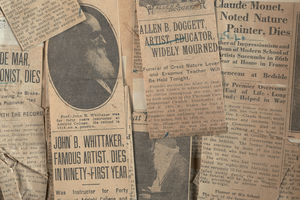
A new book explores the deaths of artists and the ex-con turned Metropolitan Museum of Art staffer who collected their obituaries.
TD Original
A new book explores the deaths of artists and the ex-con turned Metropolitan Museum of Art staffer who collected their obituaries.
 TD Original
A long-lost anti-war novel by Louis-Ferdinand Celine gets the English translation it deserves.
TD Original
A long-lost anti-war novel by Louis-Ferdinand Celine gets the English translation it deserves.
 TD Original
The language is always evolving, but will mainstreaming evermore hypersensitive euphemisms for “death” really keep the Grim Reaper at bay?
TD Original
The language is always evolving, but will mainstreaming evermore hypersensitive euphemisms for “death” really keep the Grim Reaper at bay?
 Film
Fifty years ago, the New Hollywood made one brave last stand before being TKO’ed by empty spectacle and endless sequels.
Film
Fifty years ago, the New Hollywood made one brave last stand before being TKO’ed by empty spectacle and endless sequels.
 Film
Was the maker of ‘Attack of the Crab Monsters’ and ‘Death Race 2000’ our most important independent filmmaker? Yes, he was.
Film
Was the maker of ‘Attack of the Crab Monsters’ and ‘Death Race 2000’ our most important independent filmmaker? Yes, he was.
 Sports
In Green Bay, the chant “We own you” has a double meaning.
Sports
In Green Bay, the chant “We own you” has a double meaning.
You need to be a supporter to comment.
There are currently no responses to this article.
Be the first to respond.