Captain America: Domestic Terrorist?
Trump’s labeling of antifa as a domestic terror group makes no sense. But it does put an iconic superhero in the crosshairs of the Justice Department. Captain America has been emphatically antifascist since bursting onto the comic book scene during World War II. (Courtesy of Marvel Comics)
On Sept. 17, capitalizing on Charlie Kirk’s murder a week earlier, Donald Trump wrote on Truth Social, “I am pleased to inform our many U.S.A. Patriots that I am designating ANTIFA, A SICK, DANGEROUS, RADICAL LEFT DISASTER, AS A MAJOR TERRORIST ORGANIZATION. I will also be strongly recommending that those funding ANTIFA be thoroughly investigated in accordance with the highest legal standards and practices.”
As with all of Trump’s proclamations, there’s a lot wrong with this, starting with the most obvious: Antifa isn’t an organization. It has no office, no telephone number, no mailing address, no letterhead. “Antifa” is merely short for “antifascist.” Presumably everyone in the world who believes in the principles of democracy is against fascism, therefore “antifa.” Since it’s not an organization, it should be clear even to President Trump that it can’t be a terrorist organization.
However, if it were an organization, and if that organization needed a mascot, American history provides an excellent one: Captain America.
It should be clear even to President Trump that it can’t be a terrorist organization.
In December 1940, as the Luftwaffe blitzed London, a new superhero in an American flag–themed outfit debuted on American newsstands. Created by New York artists Jack Kirby and Joe Simon, Captain America started off with a literal bang: The cover of issue No. 1 showed him socking Adolf Hitler on the jaw. The issue was a great success, selling 1 million copies. It also drew death threats for Simon and Kirby from Americans who were pro-Nazi and fans of Hitler. Mayor Fiorello La Guardia called them and said not to worry, the city of New York would protect them.
In MAGA’s new political schema, Captain America should be detained. But we shouldn’t expect him to go lightly. “The price of freedom is high; it always has been. And it’s a price I’m willing to pay,” he declared in the 2014 film “Captain America: The Winter Soldier.”
Captain America was conceived in the summer of 1940, when Kirby and Simon watched with mounting anger as Nazi Germany devoured Europe and the United States sat on the sidelines. Unable to stomach their country’s neutrality, they took matters in their own hands by creating a character willing to take on Hitler.
“Jakie” Kirby was born Jacob Kurtzberg on New York’s Lower East Side in 1917, the older of two sons of garment workers who had emigrated from Austria. The constant fighting with other kids’ street gangs — Jewish boys against Irish, Italian and Black — made him tough and pugnacious. It also left him with the intimate understanding of hand‑to‑hand combat that would show up in his brawny drawings.
“I hated the place,” he would recall of the neighborhood. “I wanted to get out of there!” He escaped by walking up to the movies on 42nd Street, and by reading newspaper comic strips. He said he found his first pulp magazine, Wonder Stories, floating in a gutter. He saw the drawing of a rocket ship on the cover and was hooked. Except for one week as a student at the Pratt Institute in Brooklyn, where his parents couldn’t afford to have him stay, and he didn’t fit in anyway, he was a self-taught artist.
By 18, he was drawing editorial cartoons and comics for newspapers, signing them Jack Cortez, or Jack Curtis, and finally settling on Jack Kirby, which he made legal to his parents’ dismay. While still a teen he worked for a while in Max and Dave Fleischer’s animation studio, helping to draw Popeye and Betty Boop cartoons.
His career took off with the rise of the comic book industry in the late 1930s. Comic strips had been appearing in newspapers since the turn of the century, but it wasn’t until the Depression years that Max Gaines (born Max Ginzberg in the Bronx), a printer’s salesman racking his brain for some way to feed his kids, struck on the comic book format. The startling success of the first Superman comic book in 1938 set off a mad scramble of competitors and imitators. Characters, titles and whole companies rose and fell at a phenomenal clip. Kirby worked for the legendary Will Eisner’s studio, where he met Bob Kahn (who, as Bob Kane, would create Batman).
In MAGA’s new political schema, Captain America should be detained.
Then there’s Joe Simon, born Hymie Simon upstate. He was 23 when he came to New York City in the midst of the Depression, took a room in a boardinghouse in Morningside Heights and started his career in the burgeoning new comic book field. His first assignment was a Western. His first superhero was called the Fiery Mask. He also did a Tarzan knockoff called Trojak the Tigerman.
Simon and Kirby met in 1939 and teamed up to create a series of characters who failed to impress readers, despite wonderful names like Master Mind Excello, the Fin, Flexo the Rubber Man and the Phantom Bullet. Then in 1940, inspired by watching Hitler rampage across Europe, they came up with one of the most popular comic book heroes ever: Captain America, the Sentinel of Liberty. His real name was Steve Rogers, a skinny art student from Brooklyn. Trying to enlist, he flunked the Army physical but was accepted into a test program, taking Super Soldier Serum and Vita-Rays that transformed him to physical perfection.
In 1944, four years after the debut of Captain America, Kirby got the chance to fight Nazis personally. Drafted into the Army, he landed with the 11th Infantry at Omaha Beach two months after D‑day. A lieutenant who recognized him as the Captain America cartoonist made him an advance scout, sending him in front of their unit to sketch the terrain. Kirby was hospitalized after developing a severe case of trench foot and thought for a while he might lose his legs. He was sent home in January 1945, his legs intact.
Rooted in Truth.Independent by Design.
Your support helps ensure that rigorous reporting, thoughtful analysis, and investigative journalism remain accessible to everyone.
Support independent journalism.
 Courts & Law
Last week's convictions related to a July 4 ICE detention center demonstration raise red flags about the right to protest.
Courts & Law
Last week's convictions related to a July 4 ICE detention center demonstration raise red flags about the right to protest.
 Editorial Cartoons
 Editorial Cartoons
 Editorial Cartoons
 Opinion
Trump's executive order is designed to create enemies everywhere.
Opinion
Trump's executive order is designed to create enemies everywhere.
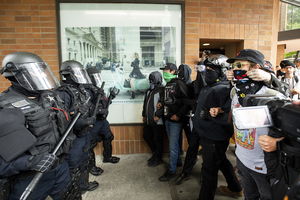 Publications refuse to distinguish between those fighting hate crimes and those who commit them.
You need to be a supporter to comment.
There are currently no responses to this article.
Be the first to respond.