Trump’s Tweets Are a New Form of Governing by Edict
In driving the news, the president-elect's "tweedicts" gain the power of implied threats.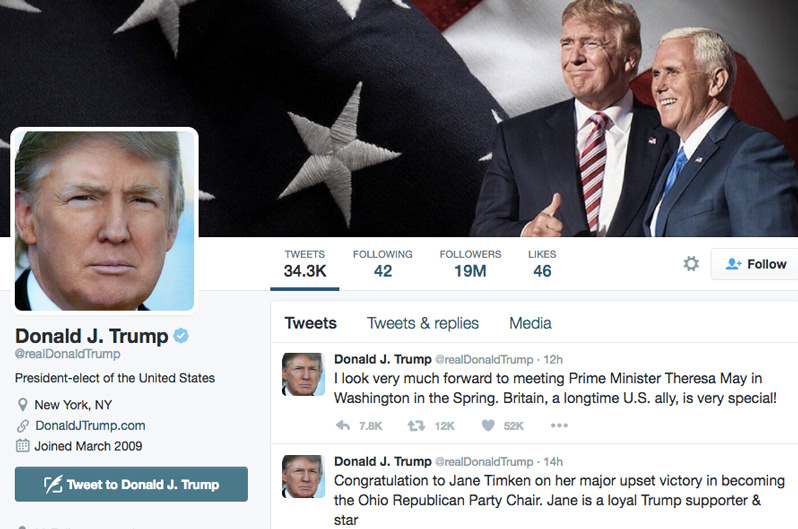 Screen shot / Twitter
By Robert Reich / RobertReich.org
Trump’s tweets are a new form of governing by edict. They’re “tweedicts.”
Incoming White House press secretary Sean Spicer says “Whatever he tweets, he is going to drive the news.”
That’s the problem. In driving the news, Trump’s tweedicts gain the power of implied threats – that he’ll, for example, sanction a particular company (Ford, General Motors, Carrier, or Boeing); unilaterally alter foreign policy (recognize Taiwan, encourage Israel to expand on the West Bank, not back NATO against Russian aggression); unleash his angry followers on a particular critic (a local union leader in Michigan, a teenage girl in New Hampshire, a TV news host); cause customers or readers to boycott a media outlet (CNN, the Arizona Republican, Saturday Night Live, the cast of Hamilton); or impose high political costs on Republican members of Congress (for pursuing an investigation against Russia, gutting an ethics office).
The United States is supposed to be a government of laws, not of
edicts. Yet Trump’s tweets are gaining power even though they aren’t
legislation. They aren’t executive orders (which can be reviewed and
overturned by courts). They aren’t even the statements of a president
using his “bully pulpit” to make a general point, because they single
out particular companies and people.
They are arbitrary and capricious,
reflecting the daily whims of Donald Trump.
And he’s not even president yet.
The media argue that the thoughts of a president-elect are “inherently newsworthy.” Rubbish. They’re newsworthy only because they drive the news. And they drive the news only because they’re considered by the media to be newsworthy.
That tautology can turn into a vicious cycle leading to tyranny. The media should pay less attention what Trump is tweeting and more attention to what Trump is actually doing.
Independent journalism is under threat and overshadowed by heavily funded mainstream media.
You can help level the playing field. Become a member.
Your tax-deductible contribution keeps us digging beneath the headlines to give you thought-provoking, investigative reporting and analysis that unearths what's really happening- without compromise.
Give today to support our courageous, independent journalists.
 Labor
The first-of-its-kind victory at the Chattanooga Volkswagen factory proves autoworkers in the South are beginning to see the value in unionizing their place of work.
Labor
The first-of-its-kind victory at the Chattanooga Volkswagen factory proves autoworkers in the South are beginning to see the value in unionizing their place of work.
 The offer includes "major gains" for workers who have been picketing at U.S. factories for a month, United Auto Workers officials say.
 A bitter standoff over fuel efficiency has been threatening to unleash years of court fights and confusion in the U.S. auto industry.
 The Truthdig columnist goes to Anderson, Ind., to witness the impact of the flight of General Motors jobs.
 Director Kathryn Bigelow turns the tragic events of July 1967 in Detroit into a tense suspense film.
You need to be a supporter to comment.
There are currently no responses to this article.
Be the first to respond.