Trump TV Ads Used $20 Million in Homeland Security Funds
The White House moved the funds into a Customs and Border Protection budget line intended for "commemorative events" related to border security, federal records show.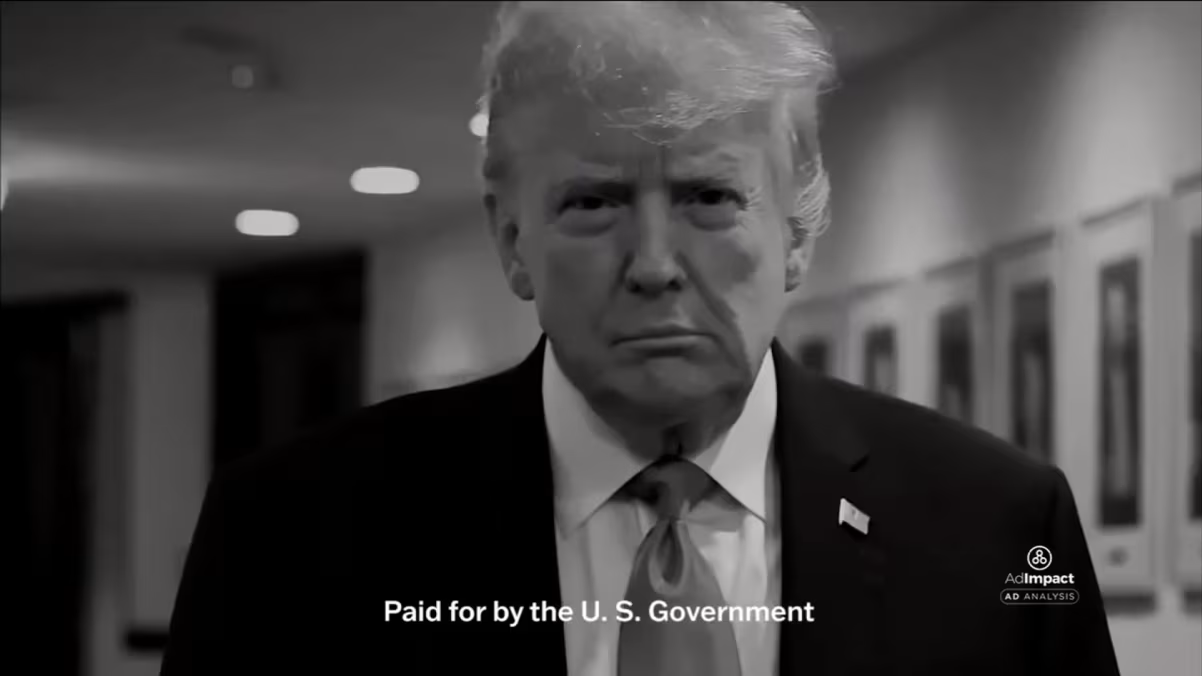 President Donald Trump appears in a taxpayer-funded public service announcement that critics say is nearly identical to a 2024 campaign ad. (Truth Social)
President Donald Trump is tapping $20 million in Department of Homeland Security funding to pay for TV ads that heavily feature him ahead of the midterm elections, Democrats said Tuesday as the promos critics call propaganda come under bipartisan attack.
The Trump administration recently moved the funds into a U.S. Customs and Border Protection budget line intended for “commemorative events” related to border security, according to federal records. Congressional Democrats said the dollars appear to be funding the ad campaign.
The ads face mounting criticism as Republicans confront an angry electorate that, according to polling, appears likely to place Democrats in control of the House and possibly the Senate. Yet the messaging reflects Trump’s strategy of centering the election on himself and telling supporters to vote as if he was on the ballot, as he urged during the GOP midterm convention.
The three ads released so far feature stylized imagery of Trump and include “Paid for by the U.S. Government” disclosures. One is nearly identical to a 2024 Trump campaign ad. Some $2 million in ads have aired on cable and broadcast stations over the past week.
“This is the final battle,” Trump says in a voiceover in one black-and-white ad that shows him walking silently toward the camera. Another ad uses the song “Love Me” by the artist JMSN. Attorneys for the performer have sent a cease-and-desist letter to the administration demanding the ad be taken down.
Both Dems and Republicans object
Senate Minority Leader Chuck Schumer, a New York Democrat, slammed the ads as indistinguishable from Trump’s 2024 campaign ads, yet funded by taxpayers. “It’s an absolute violation of what democracy is supposed to look like. Americans sat down to watch football, not to be force-fed Trump’s propaganda on their own dime,” Schumer said Monday on the Senate floor.
“It’s an absolute violation of what democracy is supposed to look like.”
Some GOP senators have also split with the Trump administration over the ads. Senate Majority Leader John Thune, a South Dakota Republican, told reporters that while he liked the ads’ message, tax dollars shouldn’t pay for them. Republican Sens. John Kennedy of Louisiana and John Cornyn of Texas have also pushed back, among others.
“I don’t think any public official, including President Trump or [former Homeland Security Secretary Kristi] Noem or John Kennedy, should spend public money on private ads for themselves,” Kennedy told “Face the Nation” on CBS.
$20 million materializes
On Tuesday, Sens. Patty Murray of Washington, the top Democrat on the Senate Appropriations Committee, and Christopher Murphy of Connecticut, the ranking Democrat on the Senate Appropriations Homeland Security Subcommittee, in a letter to Homeland Security Secretary Markwayne Mullin, said his department appeared to have dedicated $20 million to the ads that had been provided to U.S> Customs and Border Protection, a sub-agency of the DHS, in the One Big Beautiful Bill Act last year.
House Democratic Reps. Rosa DeLauro of Connecticut and Henry Cuellar of Texas in their own statement also cited federal apportionment changes by the Office of Management and Budget recorded by OpenOMB, a nongovernmental database that tracks apportionments.
OpenOMB shows that on Sept. 19, $20 million was moved into a fund that pays for border security commemorative events and previously held just $500,000.
The following day, Homeland Security awarded a $20 million contract to LMD Agency Inc., a Maryland-based marketing firm, for a “national media campaign,” according to federal contract data.
Republican blocks resolution on ads
Sen. Maggie Hassan, a New Hampshire Democrat, sought unanimous consent in the Senate on Tuesday to pass a resolution stating that the federal government shouldn’t pay for the ads.
“The Department of Homeland Security should be working to tackle the enormous national security threats we face like stopping fentanyl, not bankrolling a vanity project for the president,” Hassan said.
Sen. Cynthia Lummis, a Wyoming Republican, objected, saying the heart of the ads is about defending American values from communism and socialism. Lummis said if that message has Hassan concerned, it says “more about her side of the aisle than it does about” the ads. The action by Lummis halted action on the resolution.
Administration defends ads
The White House and Homeland Security didn’t deny that the government fund was being used to pay for the ads, in response to questions from States Newsroom.
The White House said in an unsigned statement that the ads — which it calls public service announcements — are educational and intended to remind Americans “to love their country and understand what makes it worth defending, at home, at our borders, and abroad.”
The Homeland Security Department referred States Newsroom to a White House webpage that also defends the ads. The page says they aren’t campaign ads, noting that Trump isn’t on the ballot and that the messages include no call to action.
Government ethics and legal experts say that explanation misses the point.
“There’s a distinction between providing people with information about government programs and engaging in communication that merely aggrandizes government officials. And what we have here is purely aggrandizing Donald Trump,” Samuel Bagenstos, who served as general counsel to the Office of Management and Budget during the first year and a half of President Joe Biden’s administration, said in an interview.
“What we have here is purely aggrandizing Donald Trump.”
Bagenstos, who is now a professor at the University of Michigan Law School, said that if the issue was simply whether the ads violate the Hatch Act, a federal law that limits federal employees — but not the president — from engaging in partisan politics on the job, the question of the ads’ legality could be more complicated.
But the most important legal issue with the ads, he said, isn’t the Hatch Act but whether the messages violate prohibitions on using government funds for propaganda.
During his time in government service, which also included a stint as general counsel to the Department of Health and Human Services under Biden, Bagenstos said agencies were constantly communicating with the public, and there’s always a question of how far officials can go. But he said these kind of issues were reviewed carefully, often in ways that annoyed communications staff who wanted to put out messages immediately.
“But if something like this had crossed my desk, I would have said, ‘You can’t pay for this ad. It is clearly illegal,’” Bagenstos said, adding that the ads are the kind of thing he would have considered resigning over. “It’s that clear a violation of law and it’s really corrosive to democracy,” he said.
Similarity to franking?
Members of Congress and state-level officials regularly release slick official communications that sometimes echo campaign messaging. But that practice, known as franking, comes with clear restrictions, including a U.S. House prohibition on mass mailings 60 days before an election.
In sending franked mail, members of Congress are barred from sending mail that “solicits political support” for the lawmaker or any person or political party, Margaret Dylus-Yukins, senior legal counsel for ethics at the Campaign Legal Center, wrote in an email.
There’s no apparent connection to any federal program or service.
The Trump ads, by contrast, don’t pertain to any policymaking process or function of government, and, while the White House has said the messages remind Americans to love their country, there’s no apparent connection to any federal program or service, Dylus-Yukins wrote.
Instead, she wrote that their inflammatory language, widespread distribution and touting of Trump’s term in office, as well as their close proximity to the midterms, “all suggest that these advertisements were produced with the intent to solicit political support for President Trump’s political allies ahead of the midterm election.”
“These advertisements therefore appear to be in violation of the Hatch Act and raise serious concerns about the use of taxpayer funds to possibly sway the upcoming election’s outcome,” Dylus-Yukins wrote.
No lawsuit yet
As of Tuesday afternoon the ads didn’t appear to face a legal challenge.
The watchdog group Democracy Forward said Monday it was launching an investigation into the ads and had filed records requests for communications regarding the ads and financial paperwork related to them.
Bagenstos suggested the courts may not be the best avenue to fight the ads. Instead, he said, Congress needs to assert itself and retaliate against inappropriate spending.
“In our separation of powers system, what our framers expected was that Congress would stand up for its power first,” Bagenstos said.
Rooted in Truth.Independent by Design.
Your support helps ensure that rigorous reporting, thoughtful analysis, and investigative journalism remain accessible to everyone.
Support independent journalism.
 Editorial Cartoons
 Editorial Cartoons
 Women
The DHS routinely describes undocumented immigrants as sexual predators while employing men accused of child sexual abuse, rape and other gender-based violence.
Women
The DHS routinely describes undocumented immigrants as sexual predators while employing men accused of child sexual abuse, rape and other gender-based violence.
 TD Column
After listening to voters and threatening the future of paramilitarized immigration enforcement, Democrats sign a budget deal that sets the stage for half-measures and spineless compromise.
TD Column
After listening to voters and threatening the future of paramilitarized immigration enforcement, Democrats sign a budget deal that sets the stage for half-measures and spineless compromise.
 Editorial Cartoons
 Immigration
ICE and hospital administrators are violating medical ethics by blocking staff from contacting family members for people in custody.
Immigration
ICE and hospital administrators are violating medical ethics by blocking staff from contacting family members for people in custody.
You need to be a supporter to comment.
There are currently no responses to this article.
Be the first to respond.