The First Lady and the Showgirl
As Paris burned, Céline Dion reasserted celebrity culture as the soul of modern France. Singer Céline Dion, left, declined to meet with French first lady Brigitte Macron and her husband Emmanuel, the president, backstage after they attended her concert in Paris on Oct. 16. (Photos by Creative Commons; Graphic by Truthdig)
Amid the Paris riots’ last gasp in late October, much of French society was focused on another story, this one with two female celebrities at its center: Céline Dion and President Emmanuel Macron’s wife, Brigitte.
As reported initially by the French celebrity magazine Voici, what happened was this: On Oct. 16, Emmanuel and Brigitte Macron went to see Céline Dion the night before she concluded her residency at the luxurious Plénitude Arena, which has dominated French news like a prolonged royal wedding. The scandal begins with the Macrons arriving late to their private box, and deepened when Macron was seen admonishing his wife that her dancing was too frivolous. Lip readers have not been able to reconstruct his stern words to Brigitte, but they resulted in the first lady obediently ending her groove. Further compounding this outrage, Macron shamefully continued to talk to his wife during the show! Did he not realize where he was?
The final act came when the Macrons sent a message to Céline that they would like to visit her dressing room and present their compliments. According to Voici, the singer refused.
Cool heads might remark that this is hardly a story at all, given the sketchy details, not to mention the catastrophic rioting that engulfed the capital the next day. But as with stories about the royal family in the U.K., the French public has developed an insatiable need for these superstar adventures. The Dion scandal arrived amid another scandal in progress over the singer Patrick Bruel (real name Patrick Benguigui, born in Algeria), whose attempted comeback at age 67 has been met with more than 20 accusations of rape and sexual misconduct. His most public accuser is an old girlfriend who is a celebrity in her own right, the popular TV presenter Flavie Flament.
While in America the line between celebrity and politics is deliberately blurred — with celebrities wanting to go into politics, and politicians setting out to become celebrities — in France these two worlds rarely meet. In the French imagination, the figures in the celebrity magazines exist in a different, better world. Like the British royal family, French celebrities keep their opinions to themselves. Brigitte Bardot broke this rule spectacularly by coming out as a Le Pen supporter, describing Marine Le Pen as the Joan of Arc of the 21st century and regularly backing her in elections. As a result, she traded her astonishing level of fame for the profile of a reclusive promoter of animal rights, in particular cats, whose rights she believed, for some reason, the far-right was going to safeguard. (It is probably no coincidence that Le Pen is also a famous cat lady, though rights for cats form no part of her official program.)
In the French imagination, the figures in the celebrity magazines exist in a different, better world.
Céline Dion refusing to meet the Macrons is less a signal that she prefers left- or right-wing alternatives to Macron’s brand of radical centrism — who knows what she thinks about any of that, if anything? — than a recognition that for the general public, her megawatt star power puts her miles over the heads of the president of France and his minor celebrity wife. But even a minor celebrity is more legitimate than a mere politician in many people’s eyes. The first lady is a cultural force at 73 and considered the ideal boomer sex symbol: fiercely loyal and undeniably chic.
There are gradations within the hierarchy of French celebrities, known as a class as “les peoples.” Whereas nobody dislikes Brigitte Macron, everybody worships Céline Dion. Although Dion is also not actually French, she speaks native French and that is enough to allow her to occupy the highest level of people-hood as far as the French are concerned — something between a goddess and a saint. Her concerts are a national event that for many people are more important than the riots or the visit by the pope that also took place during her Paris residency.
The French haven’t seen the world like this forever, though. It had a definite beginning.
**
It was a French magazine that invented modern European celebrity culture. Before the Second World War, sports stars were photographed and described in sports magazines, and film stars were covered in cinema magazines. Music stars, opera singers, scandalous high society figures, and especially royalty and the aristocracy, each had dedicated fans and their own media. France being a republic, it had no royal family of its own, but much of the population has maintained an intense interest in royalty: Magazines with the engagement photos of minor princes and princesses continue to sell well in France.
In 1949, an enterprising publisher had a brilliant idea. Weren’t these different kinds of stars actually all kind of the same? So, a sports magazine called Match l’intran, founded in 1926 as a supplement to a newspaper called L’intransigeant (the Match in question being a soccer or boxing match) was relaunched and repurposed as Paris Match, shifting the world on a new axis.
Paris Match is still in a class of its own. Only Vogue competes with it as the place to have your photos appear, but apart from pure celebrity stuff it has always managed to maintain a dose of serious journalism, covering wars and politics. A permanent feature is just photos of famous people, mostly in evening dress, appearing with their dates at glamorous public occasions such as gala dinners or state visits.
The formula was simple and extraordinarily successful: expensive glossy paper, the best photographs money could buy, and years and years of stories about the famous. The big break came in 1955, when Paris Match ran a photo essay of Grace Kelly with her fiancé, the rather sinister Prince Rainier III of Monaco. Their marriage the following year — uniting Hollywood royalty and the real European kind — was the most glamorous event in the world. The celebrity playground invented in the pages of Paris Match had come to life. For the French, the event and accompanying coverage ushered in generations of total obsession with celebrities.
For 50 years, the Top Gun among French celebrities was someone few non-French have heard of: the Elvis imitator Johnny Hallyday. Since his debut in 1963, Hallyday was the most famous French people by far. Born in Belgium as Jean-Philippe Smet, he launched his career on French TV singing rock ’n’ roll in black leather and riding a Harley-Davidson. It is impossible to overstate Hallyday’s impact on France. For six decades, presidents crumbled before him.
The people press has yet to recover from Hallyday’s death in 2017. The magazines that relied on him for so long still manage to find stories to get his name and face on their covers. The only person who comes close to his people power today is Céline Dion. Did Emmanuel Macron really talk rudely during her show? In the end, it doesn’t matter. Even the thought that he did is enough to sell millions of copies of brightly colored magazines.
Rooted in Truth.Independent by Design.
Your support helps ensure that rigorous reporting, thoughtful analysis, and investigative journalism remain accessible to everyone.
Support independent journalism.
 Film
A new biopic serves up a portrait of the chef as a young man.
 Opinion
Cultural commentary once tried to explain how society could do a little bit better. Now the point is to tell people only what they want to hear.
 The Trump administration views children not as the promise of a future, but as a threat to the present.
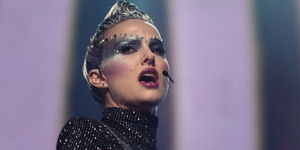 Even Portman’s strong presence, matched by a stellar Jude Law, can’t save actor-turned-filmmaker Brady Corbet from a troubled sophomore effort.
 "Scheer Intelligence" podcast host Robert Scheer and guest Jennifer Rothman cover a topic that was once the concern of a relatively few famous and powerful people but has now become just about everybody's business.
 The actor's apology to the United States' northern neighbor followed closely on his blunt commentary about President Trump at Sunday night's Tony awards.
You need to be a supporter to comment.
There are currently no responses to this article.
Be the first to respond.