The Knee Heard ’Round the World
An interview with Colin Kaepernick about his new memoir of football, protest and betrayal at the dawn of the Trump era. San Francisco 49ers quarterback Colin Kaepernick, center, kneels as the national anthem is played before the NFL team's preseason game against the San Diego Chargers on Sept. 1, 2016, in San Diego. (Graphic by Truthdig; image by AP Photo)
During the national anthem of the first three 2016 NFL preseason games, San Francisco 49ers quarterback Colin Kaepernick sat down on his team’s bench between two Gatorade coolers. Few noticed, and nobody made mention of the gesture until a Black reporter for NFL Network named Steve Wyche asked him about it following the third exhibition tilt, a home game against the Green Bay Packers. Wyche’s interview with Kaepernick put the quiet protest on newsfeeds across the country. Then, shortly after police shot and killed Alton Sterling and Philando Castile within a 48-hour period — Kaepernick and a teammate, safety Eric Reid, went a step further before the final preseason game on Sept. 1. Instead of sitting on the bench during the anthem, they took a knee. The rest is civil rights and sports history.
The story of Kaepernick’s life before and after that fateful stand is the subject of his new memoir, “The Perilous Fight,” co-written with Pulitzer Prize-winning journalist and author Nick Chiles. Kaepernick’s journey from a shy adoptee of color to white parents uninterested in exploring his Black experience, to a boldfaced protest icon is a singular American story, whose hinge moment came at the cusp of the Trump era. The book, which comes out tomorrow, will be available at most places where books are sold — but not Target. Kaepernick is boycotting the retailer over the company’s anti-diversity, equity and inclusion initiatives. I spoke with the author in late August. Our conversation has been edited for length and clarity.
Truthdig: Beginning where the book begins, have you thought about what it means to be a public face for adopted children?
Colin Kaepernick: It’s interesting, I didn’t actually hear much about adoption prior to the 2016 protest, which is when I got a surprising amount of letters and feedback from adoptees. It wasn’t immediately on my radar because being adopted is just life for me; like a regular Tuesday, right? But as more and more people reached out over the years, I’ve become mindful and intentional about showing the positive elements of it, but also the realities, and what it requires to work through all of it. Looking back, it’s natural this position came into my realm. I try to represent our community appropriately.
How were you able to grow as a person at the University of Nevada-Reno?
I was fortunate to find the right relationships early on. Some I stumbled into, like the one with my roommate-teammate Virgil Green. He invited me to attend Second Baptist Church, which became a second home for me because Reno wasn’t overly welcoming to its small Black population either. The town’s historical nickname is “The Mississippi of the West.” Later on in college, another teammate, future Super Bowl champion Brandon Marshall, introduced me to the Kappas, an esteemed Divine Nine Black fraternity, which I didn’t even know we had because the campus population was so small.

One of the funniest moments in the book is your dad getting all worked up and questioning you because he thinks it’s an “Animal House” situation.
Yeah, Dad. Not the same thing at all. The Kappas gave me a great sense of community, and I’ll add one more to the mix. The Center is a multicultural campus spot where if you weren’t white, you could go hang out and relax. I made a lot of friends there as well. I had these three safe spaces where I could have conversations I never had [growing up] back in Turlock [California]. I explored ideas and concepts I hadn’t been exposed to previously, so even with the demands of football, college allowed me to grow and develop in important ways.
I revisited your NFL highlight reels and will confess to forgetting how ahead of your time you were. Lamar Jackson and Josh Allen were certainly watching. Do you hope to reclaim yourself as a quarterback, because in many ways it’s been overshadowed and even memory-holed?
I became the 49ers’ starter in 2012, which is when you start to see a broader shift in the style of quarterback play towards what we see today. Mobile with a lot of movement, beat defenses with your arm and your legs. I’m proud of what I accomplished, but the league’s response to the protest itself is the reason my career isn’t remembered in the way it should be. The NFL did significant work to delegitimize the on-field performances to justify blackballing me.
Delegitimizing is an evenhanded way of describing it.
Yes, it’s a very kind word. There was a lot of work done on that front by the NFL, but what gets missed in all of it is that if I wasn’t the caliber of quarterback that I was, nobody would’ve cared. I know how good I was because a backup QB would’ve just been shuffled off the sidelines and it would’ve been the end of it. My success as a quarterback is precisely why the protest drove the NFL crazy.
To me, the biggest surprise in “The Perilous Fight” is that your first protest in Houston was impromptu. What was it that hit you when the national anthem played?
“We’re consistently seeing Black men killed by multiple cameras.”
At that point in time, there’d been a wave of police killings, year after year on a regular basis. By then, we’re also in a different era with social media. Historically, you look at the L.A. riots, which erupted only because someone happened to shoot video of Rodney King being beaten by LAPD. One person with a VHS camera. Today, we’re consistently seeing Black men killed by multiple cameras everyone carries around. These killings coincided with the reading and research I’d been doing to understand the historical context of police brutality. Walking onto the field for that 2016 game, playing “The Star-Spangled Banner” hadn’t crossed my mind. When I heard it I asked myself, what does this actually mean to you?
Having a better understanding of the historical systems of oppression, as opposed to ‘one-off’ incidents, gave me a realization in that moment. What the United States purports to represent doesn’t represent me or a significant portion of the population. Why am I supposed to show pride in this? Steve Wyche caught me sitting in a third game, inquired, and I told him why. By the next day, the story had blown up well beyond sports media.
I joked at the time that you should offer to stand for “The Star-Spangled Banner” in exchange for playing the never-mentioned third verse.
Right, dig a little deeper and the question becomes: What is the actual intention of the national anthem? Why would I ever stand up for that? Absurd. To your point though, sure, if we’re going to ring it out in stadiums, play the full thing. Get it all out there.
There’s a major public misconception about when you changed tactics in the final preseason game and decided to take a knee. The oft-told tale is that former Green Beret and NFL preseason player Nate Boyer convinced you and teammate Eric Reid to do so, but that isn’t what happened at all. How did Boyer become part of the narrative?
The story came out that way because Nate Boyer positioned it that way. It obviously wasn’t the case, it was Eric and I. As I note in the book, I was a Black guy in a national firestorm and, supposedly, I reached out to a white guy I didn’t know to come and advise me on what to do during the national anthem? Laughable. It was Reid’s idea. The really telling part is that nobody in the media questioned Boyer’s version of events. Why? Well, if it’s Boyer’s idea, it’s a more palpable narrative to make a lot of football fans nominally comfortable.
“He was supposed to take a knee with us and then at the last minute decided not to.”
Eric and I had spoken to Nate beforehand, and he was supposed to take a knee with us and then at the last minute decided not to, which is its own situation altogether. It became a big decision for Eric and I. Should we combat this bogus story in real time, or do we stay with the protest message we’re trying to send? If the thing with Boyer becomes the focal point, then we’ve lost the impact we’re trying to achieve. We didn’t love seeing that narrative run rampant, but Eric and I decided it wasn’t the battle worth fighting.
It’s a no-win situation, but Boyer’s story did steer the conversation in public circles to one of free speech, rather than police brutality, which are two very different topics.
Very different, indeed. How the protest is talked about through those two lenses was revealing then and remains so today. People who recognize what Eric and I were doing, see it as a protest against police killing Black people, the serious need to address that and systemic oppression more broadly. The free speech piece of it was always a deflection from the core issues at hand.
Do you feel there’s a connective tissue from taking a knee to the mass public protests over the last decade, both the righteous ones following George Floyd’s murder, and opposite ones like Jan. 6?
I’ve never thought about it that way. I mainly look at the anthem protest in terms of the wins we’ve had and the progress we’ve made, but also how much more work there is to do, especially given all the resistance to creating a fair and equitable society. How loud and vocal the other side of it has gotten over the last 10 years is both surprising and not at the same time. We’ve taken major steps back, but I’d rather have it all out in the open so we know what we’re up against. It’s valuable to know where it lies.
Have you found the last decade disheartening?
At times for sure, but my hope is that the awful politics are part of a last-ditch effort. As far as where we’re at as a society, there’s a strong growing undercurrent of people saying “enough’s enough.” We’re heading in the right direction, but you have to weather the hard times. Keep playing offense in the storm.
One savvy author’s move on your part is mentioning President Donald Trump as little as possible. I thought there would be more pronounced score-settling and was sincerely hoping you’d “motherfuck” the big man once or twice. Did you go back and forth at all about your impressive restraint?
Look, that man had a direct impact, working with NFL owners to blackball me. That exists, that’s real, so there is plenty I could say about him personally—
Wouldn’t it feel good just saying it out loud?
Maybe, but I know in many ways that’s what they want. They want to be the center of the story and have relevance and influence in that way. Him in particular. There’s obviously a level of power and influence that comes with his position, but I don’t have to lean into that or accept it. I’m trying to stay focused on what’s most important. He doesn’t fit the bill.
Given the nightmare CTE report that came out this week combined with distance from your playing days, does your brain thank you for missing out on a decade of head shots, even if your heart says otherwise?
It’s a both/and answer. There’s my love of playing football, nothing else like it, with its competitive nature, the camaraderie of a group of guys coming together to win. You put yourself through so much it makes success incredibly rewarding in ways you can’t find anywhere else. And yet, there are serious consequences. I haven’t even read this week’s report yet, but I remember the one where they had more than a hundred players and every single one of them had CTE except for one, a kicker I think. If you want to play, be a kicker.
“In football, CTE is not an if, it’s a when.”
The physical consequences of football are real. My wife, Nessa Diab, and I have asked the question so many families are asking. If we have a son, will we let him play football? As a parent who knows the undeniable impact, I would like him to play other sports. In football, CTE is not an if, it’s a when. You don’t want to put your child in that situation.
On a personal level, I played football for 20-plus years, so time will tell the damage done, but am I glad I saved myself some hits? Yes. Would I love to get back out on the field? Absolutely.
You write about Jay-Z, who supported you on “Saturday Night Live,” then ignored you, later tried to co-opt you after Roc Nation partnered with the NFL, and then last summer, after the book was finished, called you out at Yankee Stadium. Do you think these will be the tabloid headlines to emerge out of “The Perilous Fight?”
I’m not sure, because there are so many different topical pieces in the book. Like the Nate Boyer story isn’t known, hasn’t been talked or written about, so I think there will be a good amount there. On the Jay-Z side, this is repetitive behavior that there’s been conversations about for quite a while. There may be some surprise around specific details, but Jay-Z’s overall actions won’t be shocking to anyone who has paid attention.
As noted in “The Perilous Fight,” you do not watch the NFL at all, but I’m curious if you’ve seen clips of Eminem taking a knee during the halftime show of Super Bowl LVI?
I had friends text me about it, but I’ve never seen it because I don’t engage. I hope solidarity is the case. And if so, while I don’t love anyone who is now doing the Super Bowl show because of the Jay-Z deal, I appreciate the sentiment.
Finally, looking back, can you believe how the last 10 years have played out? How you became a monumental public figure — and all of the fallout that came along with it — for a generally mild act of protest against an ongoing life-and-death problem for communities of color? It’s mind-blowing, no?
It really speaks to the fragility of a certain portion of society. In basic form, I’m protesting police killing Black people. The flip side of resistance to this simple human concept is — what? Police should be killing Black people? Yes, I’ve been in the center spotlight, but I’m also part of a larger movement of people publicly screaming, “Hey, you shouldn’t be killing us!”
It’s the lowest of bars to get over.
Rooted in Truth.Independent by Design.
Your support helps ensure that rigorous reporting, thoughtful analysis, and investigative journalism remain accessible to everyone.
Support independent journalism.
 Here are the six ways in which football prepared us for Trumpball and is still trying to keep us in its grasp.
 Dave Zirin, sportswriter for The Nation, examines the quarterback's blackballing by league owners and how the U.S. punishes black dissent.
 The rapper-cum-mogul's latest business venture has fans wondering whether he's betrayed Colin Kaepernick and the black freedom struggle.
 While he says he's not an activist, safety Antone Exum is eager to make his voice heard on his new song "Officer Kaepernick."
 The 23 women of the soccer team return from winning the World Cup in France to continue another, more difficult battle for equal pay.
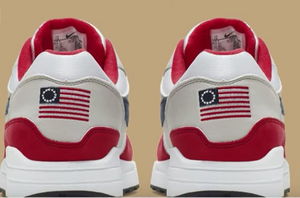 The shoemaker defers to its star NFL endorser when he raises concerns over a sneaker featuring an early American flag.
You need to be a supporter to comment.
There are currently no responses to this article.
Be the first to respond.