In Defiance of the Law, Iranian Women Shed the Hijab
The government’s confusing approach reveals internal divisions and an inability to appease a furious populace. Iranian women without a mandatory headscarf, or hijab, walk past a patriotic banner on a street in Tehran in violation of Iran's "Hijab and Chastity Law" on April 19, 2024. (AP Photo/Vahid Salemi)
Parvaneh is in Tehran, Iran, and she isn’t wearing a hijab. Her name has been changed for her safety. “Look,” she says, pointing to her head during a video call. “I am in a co-working space — do you see any kind of headscarf anywhere?” I can see her short hair and a crop top that reveals a pierced navel. She isn’t wearing any kind of headscarf, nor a manteau — the long coat that, together with the headscarf, makes up the Iranian hijab. Behind her, I can see other women, also without hijabs.
Ever since the Zan, Zendegi, Azadi (Woman, Life, Freedom) protests three years ago, images of women going about their daily lives in Iran without the mandatory headscarf have proliferated online. During those protests, Iranian youth rose up in rage after a Kurdish Iranian woman, Jina Mahsa Amini, died in custody after being detained for wearing her hijab loosely, or “incorrectly,” in September 2022. The protests were violently quashed, but since then, Iranian women have been gradually shedding their hijabs.
Last month, a female bass guitarist was seen playing without a hijab in an impromptu gig on a Tehran sidewalk. Her band’s cover of a White Stripes song was captured in a video that went viral, and people can be seen bobbing along to the music — with no headscarves in sight. Although authorities made some arrests after the video was posted, Iran’s women and youth seem to be carrying on regardless of the letter of the law.
Recently, social media has been lit up with headlines falsely declaring that Iran has finally abolished the mandatory hijab and that Iranian women, long forbidden from showing their hair, were finally free from such restrictions. Women around the world shared celebratory posts, declaring a victory for the Zan, Zendegi, Azadi movement.
But it wasn’t true. The much-touted “abolition” of the compulsory hijab could be traced back to a single comment by Mohammad-Reza Bahonar, a veteran conservative politician and member of Iran’s Expediency Discernment Council, which advises the supreme leader. Speaking to reporters, Bahonar suggested in October that the government’s harsh new “Hijab and Chastity Law” was “no longer enforceable.” His remark, quickly amplified by Iranian public media and interpreted by foreign outlets as an official policy shift, was soon walked back amid furious denials by the judiciary and hard-line clerics. The law, they insisted, “remains in force.” No law had been repealed.
The moment spoke to a quiet rebellion being led by the ordinary people of Iran.
It was a small moment of confusion that told a much larger story — about the government’s internal divisions and the information void that allows rumors to flourish. Above all, the moment spoke to a quiet rebellion being led by the ordinary people of Iran. They are taking the freedoms they want, and the weakened government doesn’t dare to push a furious population too far.
In Iran, the hijab has been a visible marker of the Islamic Republic’s legitimacy, a pillar of the government’s principles. Since the revolution of 1979, the state has woven control of women’s bodies into the fabric of its political identity. To question the veil is to question the very revolution that brought the clerics to power. This is why, even after months of protests in 2022 that drew in every generation and social class, and even after large swathes of the population have already abandoned the hijab, political leaders are unwilling to follow suit.
Toward the end of 2023, Iran’s parliament, the Majlis, quietly passed the Hijab and Chastity Law, a draconian expansion of the existing dress code that introduced tiered penalties, surveillance measures and prison sentences for women and anyone promoting violating the dress code in an “organized” manner. The law empowered the police to use facial-recognition technology and traffic cameras to identify unveiled women and to send them text warnings and block their access to banking, employment or public transport. Even online dissent — posting or liking a photo without a headscarf — became a potential crime.
Essentially, the law extended existing laws by finding ways to enforce compliance and to police hijab use. But at the end of last year, the Supreme National Security Council — reporting directly to the supreme leader — ordered that the new law not be implemented, citing the risk of renewed unrest. For once, the regime seemed to recognize its own fragility. The pause did not mean change, however; rather, it reflected a calculated attempt to defuse pressure without conceding ground.
Israel’s two-week bombing campaign of Iran in June further stoked the populace’s anger with the state. While Israel dropped bombs on densely populated areas of Tehran, the government did not activate warning sirens or provide shelters.
“We had to get through it all on our own,” Parvaneh said. “We were being bombed because of their policies, and they did nothing to protect us. And the economy is still in free fall, we have power outages and water shortages. There is so much anger that I think they don’t want to antagonize us.”
Kaveh, whose name has also been changed for his protection, was one of the many young Iranians headbanging to the White Stripes cover in the video that day on the Tehran sidewalk. “Some morality police walked by,” he said during a call from Tehran, “but they just looked the other way. Like, literally. That’s what you see a lot, they just look the other way. Either they’ve been told to do that, or they are as fed up with upholding this nonsense as we are. They’re Iranian too and I think they’ve had enough of abusing their fellow Iranians.”
“I think the Israeli attacks really brought people together, like people were helping each other instead of the regime helping us,” Kaveh added.
Bahonar’s comments last month must be understood against this backdrop. A veteran insider, he likely intended to signal flexibility to the outside world while reassuring the local interests that the revolution’s values remain untouched. But his words were taken out of their intended context and took on a life of their own. They ended up feeding an international hunger for good news on Iran women’s rights as well as the local fatigue with the endless policing of women’s appearance.
The confusion was also a product of deliberate opacity; the Hijab and Chastity Law was drafted, debated and passed largely behind closed doors. Even lawmakers were denied full access to its 70 articles, which were rushed through under a “pilot” status typically reserved for emergency economic measures. Details only emerged through leaks to human rights groups, revealing provisions that effectively privatized enforcement by requiring business owners, teachers and public officials to police women on their premises or risk prosecution themselves.
“I think the Israeli attacks really brought people together.”
When the Security Council suspended implementation, it did so without releasing a public statement. The result is a legal limbo: The old laws mandating hijab use remain on the books, while the new law exists but is officially dormant. In practice, enforcement has become fragmented — with one set of rules in Tehran’s affluent north, another in the more conservative provinces.
Women, meanwhile, are forced to navigate an unpredictable landscape. In some neighborhoods, unveiled women walk freely; in others, they face arrest or assault. Cafes and bookstores are closed for employing women without headscarves, while elsewhere shopkeepers quietly look the other way. The randomness is intentional. By keeping women uncertain about the boundaries of defiance, the state maintains the illusion of control without the risk of revolt.
The confusion is also symptomatic of a deeper crisis of authority. The Islamic Republic’s power has always rested on the perception of unity between its political and clerical institutions. But 46 years after the revolution, that unity is crumbling. Competing factions now leak, contradict and undermine each other in real time, using the hijab debate as a proxy for their own survival.
For the hard-liners, the hijab remains a sacred red line; for pragmatists, it is an unwelcome distraction from an economic crisis that has left millions in poverty. Yet neither camp is willing to address the underlying issue: the state’s inability to govern or command public support. Instead, officials oscillate between repression and cosmetic reform, each gesture calculated to buy time. The outcome is a government perpetually at war with itself and with half its population.
Ultimately, the story of disappearing hijab requirements tells us less about what the regime has done than what its people have already dared to do. On the streets, in classrooms and across social media, Iranian women are living the freedom the law denies them. The government may cling to its rules, but the revolution it fears most — the quiet, daily one led by its women — is well underway.
Rooted in Truth.Independent by Design.
Your support helps ensure that rigorous reporting, thoughtful analysis, and investigative journalism remain accessible to everyone.
Support independent journalism.
 Film
A new film chronicles the Sudanese revolution of 2019 and the young activists, poets and musicians who persevere amid war and chaos.
Film
A new film chronicles the Sudanese revolution of 2019 and the young activists, poets and musicians who persevere amid war and chaos.
 Global Voices
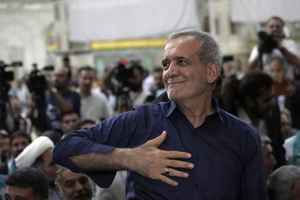
As Masoud Pezeshkian prepares to take office, domestic skepticism of his promises runs deep.
Global Voices
As Masoud Pezeshkian prepares to take office, domestic skepticism of his promises runs deep.
 Middle East
A dispatch from Tehran, where an eerie calm has fallen after the storm of the feminist uprising.
Middle East
A dispatch from Tehran, where an eerie calm has fallen after the storm of the feminist uprising.
 Nothing is more American historically than veiling and debates on veiling.
 A group of young Muslim women tries to destigmatize head coverings; The Economist is under attack for a cartoon some see as anti-Semitic; meanwhile, a Time magazine cover portrayal of Hillary Clinton has sparked a wave of online outrage. These discoveries and more after the jump.

You need to be a supporter to comment.
There are currently no responses to this article.
Be the first to respond.