Data Center Group Spent Millions to Influence Ohio Election
Silicon Valley titans are among the mega donors reportedly linked to a campaign to influence voters in the heart of the data center boom. Open AI President Greg Brockman listens as President Donald Trump speaks to reporters at the White House in Washington on Sept. 29, 2026, after meeting with top executives of AI firms. (AP Photo/Jacquelyn Martin)
A pro-AI data center group purchased at least $2.54 million worth of television ads that ran recently in Ohio, a new DeSmog analysis reveals. The group, Build American AI, is linked to Leading the Future, a major artificial intelligence industry super PAC backed by Silicon Valley billionaires.
The ads extolled the economic benefits of Ohio’s data center boom, one of the hottest issues in the state’s Senate election, but did not endorse either candidate in the race: Trump-aligned Republican incumbent Jon Husted, who was appointed by Gov. Mike DeWine to serve out Vice President JD Vance’s term, and former three-term Democratic Sen. Sherrod Brown.
“When some people hear data centers they picture computers and servers,” said one Build American AI ad. “But we see something different: electricians, engineers, manufacturers.” The ad said that data centers have brought more than $40 billion in investments and created over 95,000 jobs in Ohio.
“The future won’t be built by politicians or special interests,” the ad stated, “It’ll be built by American workers right here in Ohio.”
The ads appeared on at least 16 Ohio television stations between Sept. 7 and Oct. 21, according to Build American AI’s filings with the Federal Communications Commission, which described them as “non-candidate issue ads.”
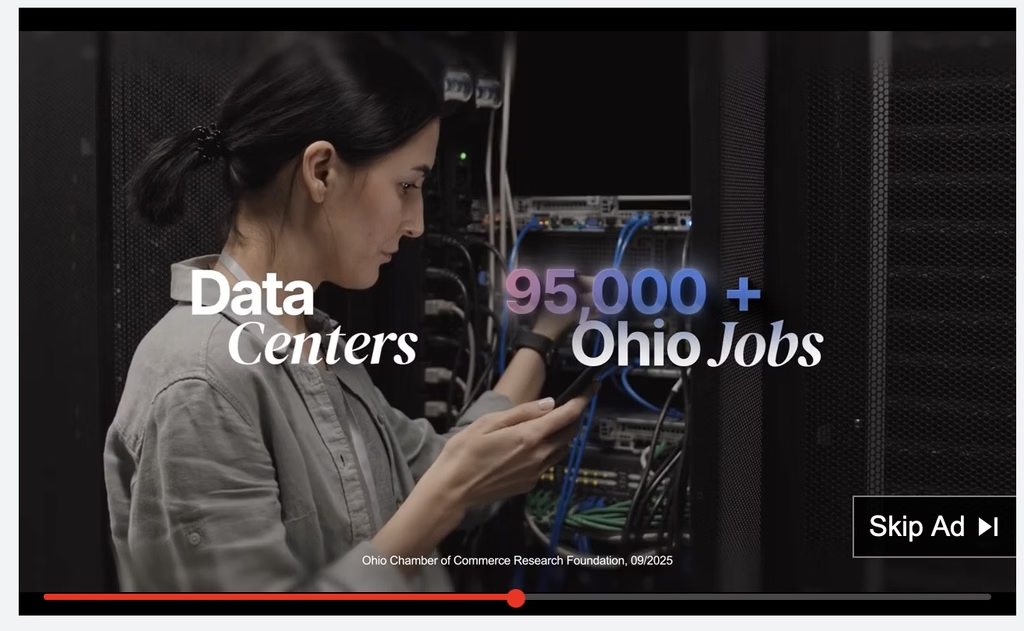
Build American AI ordered at least $2.5 million in ads in Ohio, $1.5 million in ads in Wisconsin and $1.1 million in Kansas between Sept. 7 and Oct. 24, according to DeSmog’s analysis. Jesse Hunt, the group’s head of communications, confirmed that it was spending over $5 million in the three states, but did not comment on the exact amounts.
Build American AI has been described by Politico as a “subsidiary” of Leading the Future, a super PAC formed last year to promote AI industry interests. Leading the Future has emerged as a major player in 2026 election cycle — backing both Democratic and Republican candidates in primary races earlier this year.
Build American AI ordered at least $2.5 million in ads in Ohio.
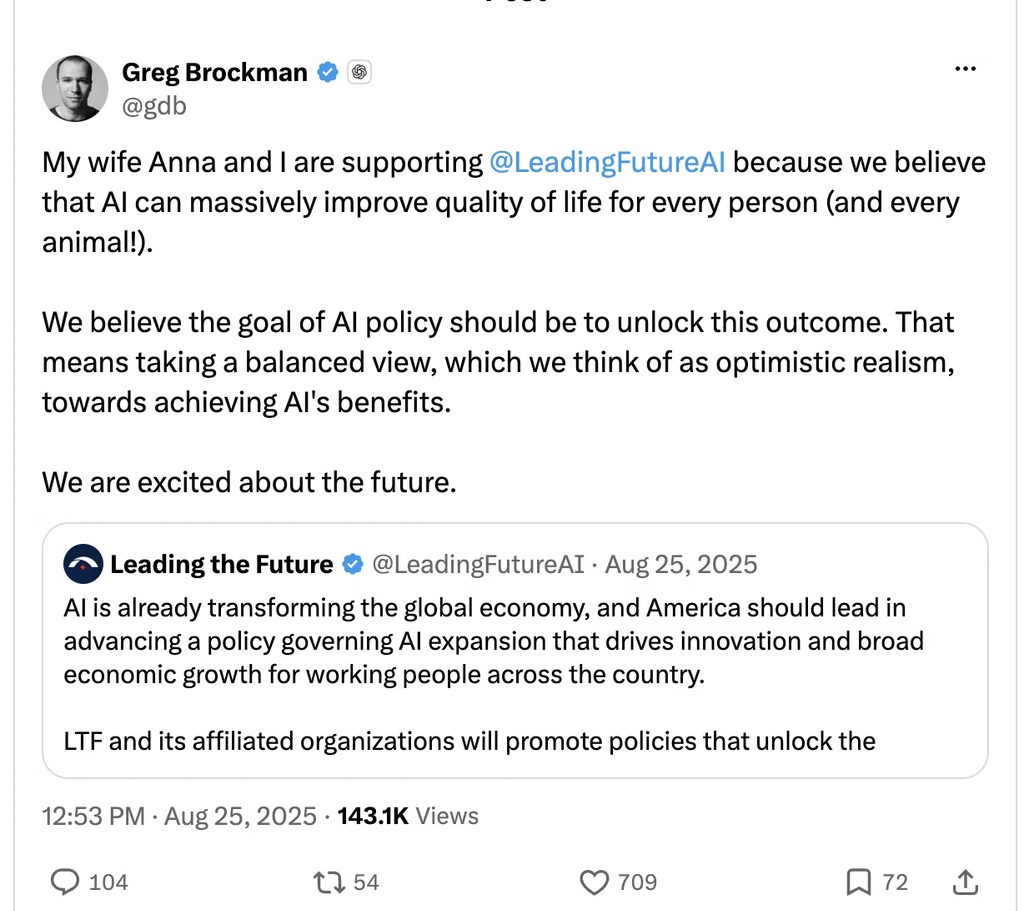
The super PAC has received about $125.79 million in contributions during the 2026 midterm election cycle as of Oct. 29, according to Federal Election Commission filings. Most of that came from a handful of donors: $25 million each in individual contributions from tech venture capitalists Marc Andreessen and Ben Horowitz, $50 million from their venture fund Andreessen Horowitz and $12.5 million each from OpenAI co-founder and President Greg Brockman and his wife Anna Brockman.
OpenAI is part of a joint venture with SoftBank, Nvidia, the U.S. Department of Energy and other partners to build a mammoth data center complex on federal land in Pike County, Ohio. The project would include an on-site gas-fired power plant designed to produce 9.1 gigawatts of power — larger than any gas-fired power plant currently operating worldwide, big enough to power about 7 million homes.
OpenAI’s investors include the Andreessen Horowitz venture capital fund. OpenAI’s energy chief is John McCarrick, who as an energy official in Trump’s first administration promoted exports of U.S. liquefied natural gas to Europe following Russia’s invasion of Ukraine and advocated for Asian countries to invest in natural gas.
Andreessen Horowitz did not respond to a request for comment.
OpenAI did not respond to DeSmog’s request for comment on the Brockmans’ personal donations to Leading the Future or its stance on using gas-fired power for its data centers.
Andreessen is also a board member of tech giant Meta, which is building Prometheus, a massive data center in New Albany, Ohio, northeast of Columbus, the capital. The partially built computing complex runs on natural gas turbines and is designed to scale to 1 gigawatt, enough energy to power about 800,000 homes.
These projects are among dozens of proposed data centers in Ohio, which is strategically positioned atop part of the Marcellus Shale, the biggest gas field in the U.S.
Andreessen is also a board member of tech giant Meta.
The AI boom is on track to worsen the climate crisis, which is on the verge of passing the key 1.5 degree Celsius (2.7 degrees Fahrenheit) limit on global heating that nations set in the 2015 Paris Agreement.
Based on current trends, the energy demand of new U.S. data centers could increase the nation’s carbon emissions by 24 million to 44 million metric tons a year between 2024 and 2030, according to a recent study published in the journal Nature Sustainability, equivalent to the tailpipe emissions from an additional 5 million to 10 million additional gasoline-burning cars.
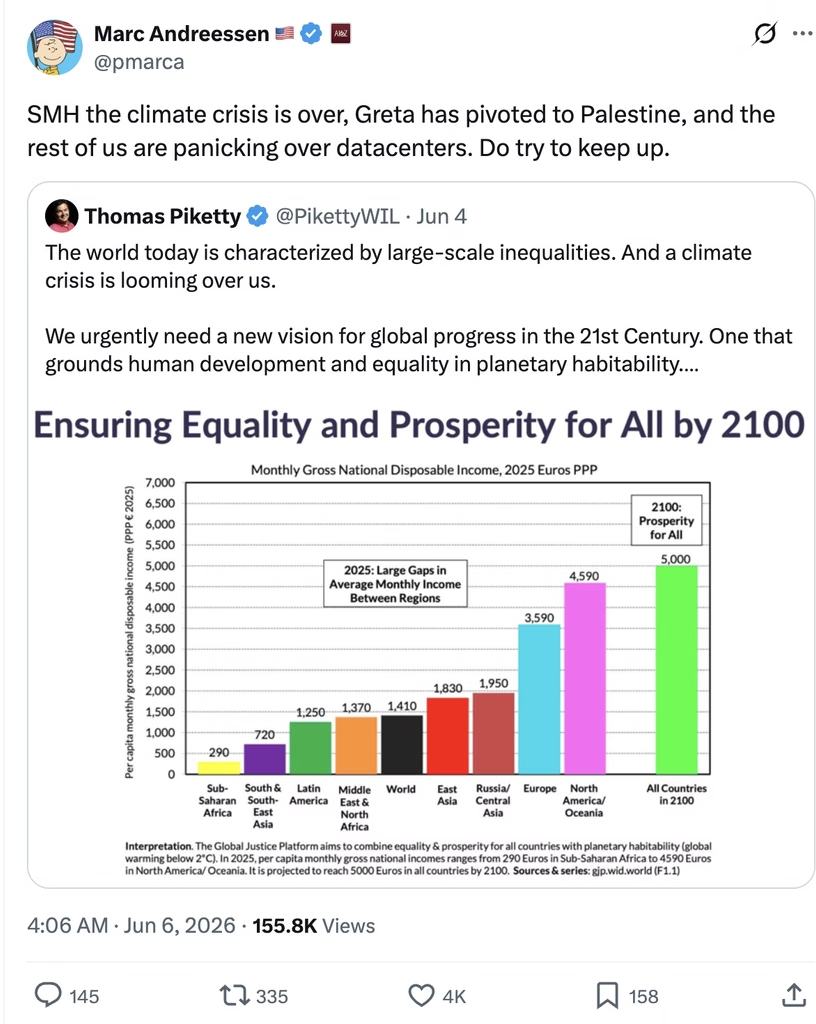
Andreessen recently called the climate crisis “over” in a post on X, and has praised hydraulic fracturing, the oil extraction technique known as “fracking,” as an “incredibly positive outcome” of energy industry research and development.
“Energy should be in an upward spiral,” Andreessen wrote in his “Techno-Optimist Manifesto” in 2023. “The more energy we have, the more people we can have, and the better everyone’s lives can be.”
He and Horowitz have each contributed at least $3,500 to Husted’s reelection campaign since late 2025, according to FEC filings.
Build American AI’s ads appeared after Brown’s campaign ran a series of ads branding Husted as “the face of data centers in Ohio” and lambasted him for supporting multibillion-dollar, greenhouse-gas spewing data center developments as well as for handing out tax breaks for data center developers.
Brown’s campaign had spent $2.4 million on ads criticizing Husted’s support for data centers as of late August, according to political ad spending tracker AdImpact.
Sixty-three percent of Ohioans oppose AI data centers.
The ads caught the attention of the National Republican Senatorial Committee, which sent out a memo in mid-August to “interested parties” about “Ohio’s data center risk,” as first reported by Axios. The memo warned that Brown’s opposition to data centers had turned the issue into “the anchor hanging around Husted’s neck” that could get him voted out of office. “The companies that need these projects built have to fix how Ohioans see them: who benefits, who pays, and why a community should want one,” the memo stated — the themes of Build American AI’s TV ad campaign.
Sixty-three percent of Ohioans oppose AI data centers, according to a recent poll by The New York Times. As of September, the state has over 125 local data center moratoriums in place, as well as 21 ballot measures across 16 counties targeting data center construction, the most of any state. “People who would wave at their neighbors that they’ve seen for 10 years but never have spent the time on their porches” are “looking past partisan differences to fight for their communities,” Nick Owens, an attorney in rural Ohio, told DeSmog. Owens, who said he is a Republican, volunteers with the campaign Conserve Ohio, which is seeking to ban large-scale data centers in the state.
Looking ahead, local community groups in Ohio are attempting to gather 413,000 signatures to put a statewide data center moratorium on the ballot in 2027.
“Grassroots people who frankly have one-hundredth the level of funds [of tech leaders] are battling these fights,” Owens said. “It’s really David versus Goliath, but the righteous people in this case, I believe, will prevail: the people who live in their communities.”
Rooted in Truth.Independent by Design.
Your support helps ensure that rigorous reporting, thoughtful analysis, and investigative journalism remain accessible to everyone.
Support our independent journalism.
 Ear to the Ground
On Tuesday, voters overwhelmingly rejected Silicon Valley’s push for a data center build-out, from sea to shining sea.
 Editorial Cartoons
 Technology
Draft artificial intelligence legislation circulated by Anthropic would permit dozens of projected deaths before triggering government intervention.
 Technology
The World Bank is bullish on AI. Experiences in the gig economy give us reason to doubt that confidence absent strong regulations.
 Editorial Cartoons
 Editorial Cartoons
You need to be a supporter to comment.
There are currently no responses to this article.
Be the first to respond.