White House Might Extend U.S. Military Support to Iraq
President Obama announced Thursday that he had authorized airstrikes in Iraq for two specific reasons, but a White House spokesman Friday indicated that the scope in the future may not be so limited. President Obama meets with his national security advisers in the Situation Room of the White House. Pete Souza
President Obama announced Thursday that he had authorized airstrikes in Iraq for two specific reasons, but a White House spokesman Friday indicated that the scope in the future may not be so limited.
Speaking from the White House earlier (video below), Obama said, “Today I authorized two operations in Iraq — targeted airstrikes to protect our American personnel, and a humanitarian effort to help save thousands of Iraqi civilians who are trapped on a mountain without food and water and facing almost certain death.”
“I’ve said before, the United States cannot and should not intervene every time there’s a crisis in the world,” the president added. However, “We can act, carefully and responsibly, to prevent a potential act of genocide. That’s what we’re doing on that mountain.”
A day later, White House spokesman Josh Earnest was quoted by Reuters as saying there could be more in the offing:
But the United States also has a third goal “related to our belief and commitment to supporting integrated Iraqi security forces and Kurdish security forces as they unite the country to repel the threat” posed by Islamic State fighters, he said, reiterating that any U.S. support will not be “prolonged” and will not involve sending U.S. troops to the country.
The United States withdrew its armies from Iraq in 2011, unable to negotiate an extended stay with the Iraqi government. Since then, an increasingly fractured Iraqi military has been unable to cope with an insurgent militant force known as ISIS or ISIL — Islamic State of Iraq and the Levant.
— Posted by Peter Z. Scheer
Your support matters…Independent journalism is under threat and overshadowed by heavily funded mainstream media.
You can help level the playing field. Become a member.
Your tax-deductible contribution keeps us digging beneath the headlines to give you thought-provoking, investigative reporting and analysis that unearths what's really happening- without compromise.
Give today to support our courageous, independent journalists.
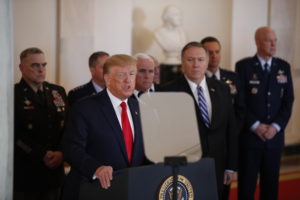 The president indicates he won't respond militarily after missile strike on Iraqi bases in which no one was harmed, tells of new sanctions.
 "This is a war crime," says the New York Democrat.
You need to be a supporter to comment.
There are currently no responses to this article.
Be the first to respond.