Travel Ban Waivers Rarely Granted, Advocates Say
President Trump’s third version of a ban on travelers from eight countries, including five majority-Muslim nations, was supposed to make exceptions in the neediest cases.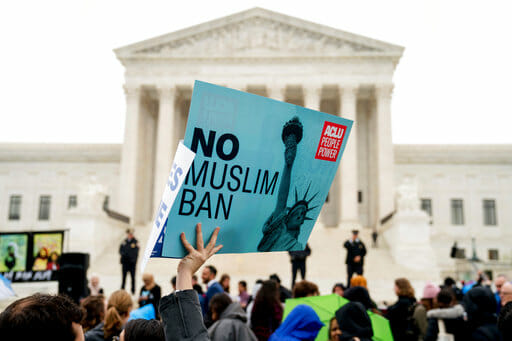 Opponents of President Trump's travel ban protest outside the U.S. Supreme Court as the justices hear arguments about the order in April. (Andrew Harnik / AP)
President Trump’s third version of a ban on travelers from eight countries remains in effect as legal challenges wind their way through the courts. One of the legal defenses for allowing it to stay in place was the option for citizens of those countries to apply for individual waivers, exceptions that would allow them into the United States. According to multiple reports, including from Reuters in March, and now The Washington Post, these waivers are nearly impossible to obtain.
“The ban,” a Reuters report explains, “contains a provision that those who do not qualify for exceptions can be considered for waivers in special circumstances, such as a need for urgent medical care or to accommodate adoptions.”
In the first month of the ban, Reuters reported, over 8,400 people from the eight countries—Chad, Iran, Libya, North Korea, Syria, Somalia, Yemen and Venezuela—had applied for visas. As of mid-February, only two people had been granted waivers.
Democratic Sen. Chris Van Hollen and Republican Sen. Jeff Flake both requested information from the State Department and the Department of Homeland Security in January, noting that they “received reports of the near uniform denial of waivers for visas.”
More than two months later, “The State Department says it has granted hundreds of waivers, but declined to say who received them and how,” according to an article Tuesday in The Washington Post.
The government says 655 people from the eight countries have been granted waivers, but as the Post notes, advocates believe that the number actually allowed into the U.S. is much lower. Even the State Department “acknowledged that a ‘cleared’ or ‘granted’ waiver does not mean the applicant actually has received a visa,” The Post reports. “A State Department official said many waiver recipients have received actual visas, but declined to give specifics.”
Lawyers for those seeking waivers have called it “window dressing” and “a sham.”
The Washington Post reached out to over 30 immigration attorneys and advocacy groups asking if they knew of anyone who had successfully obtained a waiver. The search turned up only 25 from the five Muslim-majority countries included in the ban.
For those seeking to be reunited with family, to escape war or to receive lifesaving medical treatment, the outlook is not promising. Many legal analysts expect the conservative-leaning Supreme Court to rule in favor of the ban in June.
Your support matters…Independent journalism is under threat and overshadowed by heavily funded mainstream media.
You can help level the playing field. Become a member.
Your tax-deductible contribution keeps us digging beneath the headlines to give you thought-provoking, investigative reporting and analysis that unearths what's really happening- without compromise.
Give today to support our courageous, independent journalists.
 Editorial Cartoons
 Editorial Cartoons
 Opinion
Trump blew up the Iran nuclear deal. Can Biden still fix it?
Opinion
Trump blew up the Iran nuclear deal. Can Biden still fix it?
 Editorial Cartoons
 Editorial Cartoons
 Editorial Cartoons
You need to be a supporter to comment.
There are currently no responses to this article.
Be the first to respond.