This Is Water: Fishy Advice From David Foster Wallace
A viral video adaptation of a commencement speech given in 2005 by the hugely influential late American author reaches for a healing vision of a common humanity amid the relentless crushings of a capitalized and corporatized society.
A commencement speech given in 2005 by the late American author David Foster Wallace, who is hugely influential among literary members of the generations lumped into the millennial category, reaches for a healing vision of a common humanity amid the relentless crushings of a capitalized and corporatized society.
Both the Kenyon College speech and its schmaltzy, feel-good adaptation below — which has gone viral with more than 4.5 million views since its publication May 6 — are worth hearing and seeing because they are well written and produced, and they encourage audiences to consider the struggles and predicaments of other people.
But what begins as an exciting critique of American culture slides into a mushy, contradictory and relativistic lecture about personal responsibility and the supposed power we all have to rise above the colossal societal forces distorting our lives, bodies and minds. The mind is the very thing Wallace says the graduates — whose thinking has been shaped by a dubious university system increasingly directed by corporate interests — are supposed to use to periodically free themselves, in the great American tradition of independence, from the anti-social shackles of ignorance, prejudice, irritability and selfishness, and choose “what has meaning and what doesn’t.”
The whole predicament and its potential solutions are a lot more complex than the abridged version of Wallace’s speech suggests. Further undermining the message (as Truthdig reader ADFWFan pointed out below) is the tragic fact that Wallace killed himself three years after delivering the address.
SeeTheGlossary:
Your support matters…
Independent journalism is under threat and overshadowed by heavily funded mainstream media.
You can help level the playing field. Become a member.
Your tax-deductible contribution keeps us digging beneath the headlines to give you thought-provoking, investigative reporting and analysis that unearths what's really happening- without compromise.
Give today to support our courageous, independent journalists.
 The vice president warns of global danger and tells of support as he addresses the most diverse class to graduate the U.S. Military Academy.
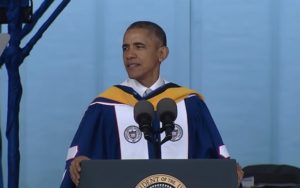 "Be confident in your blackness" was his advice as he painted a highly optimistic picture of social and economic progress in the U.S. in recent decades, even when it comes to the national scourge of racism.
 Evan Young was valedictorian of this year's graduating class at Twin Peaks Charter Academy High School in Longmont, Colo. He'd planned to give his valedictory address at the graduation ceremony May 16. But Principal B.J. Buchmann didn't give him the chance.
You need to be a supporter to comment.
There are currently no responses to this article.
Be the first to respond.