Scotland’s New Offshore Wind Turbines Power 20,000 Homes
In the first six months of 2017, moving air supplied 57 percent of Scotland's electricity, and authorities seek to have renewables provide all of it by 2020.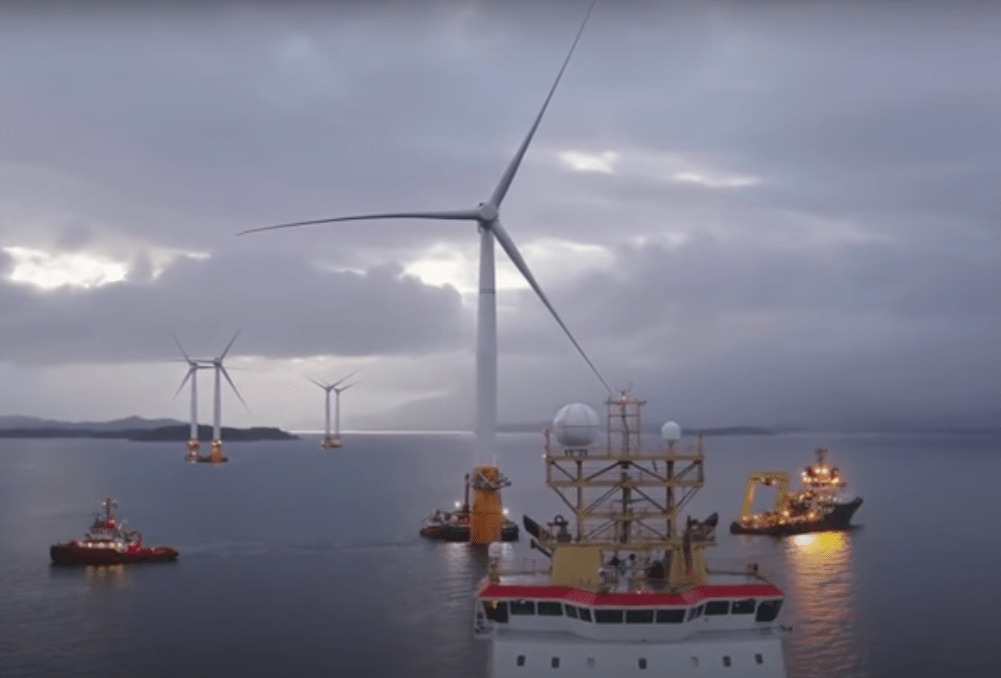 A wind turbine off the coast of Aberdeenshire in Scotland. (Screen shot via YouTube)
The BBC reports that five massive floating wind turbines off the coast of Aberdeenshire in Scotland have gone operational. They generate enough electricity to power 20,000 homes. This “Hywind” project was built by the Norwegian firm Statoil.
It is an exciting development, since a lot of high-wind areas are offshore and being able to install turbines out there will permit us to capture that energy. There is also sometimes some public opposition to onshore turbines (though it appears to be ungrounded), and putting them 10 or 15 miles out from the coast would avoid such pushback.
In the first six months of 2017, wind supplied 57% of Scottish electricity. Electricity generation from wind is up 13% from the same period in 2016.
And, in some months, wind powered the entire country. In June of this year, wind generated 113% of Scottish electricity use, which means they exported some electricity and in principle for that month did not need any natural gas. Reliably, over half of Scottish electricity comes from renewables. That figure in the United States is 10%.
Scotland wants to get 100% of its electricity from renewables by 2020, which will be about 30% of its total energy consumption (household heating, gasoline-fueled transportation, etc.)
In 2016, Scotland, which only has 5.4 million of the UK’s 66 million people (8%), was nevertheless responsible for 25% of the renewable electricity in the country.
Your support matters…Independent journalism is under threat and overshadowed by heavily funded mainstream media.
You can help level the playing field. Become a member.
Your tax-deductible contribution keeps us digging beneath the headlines to give you thought-provoking, investigative reporting and analysis that unearths what's really happening- without compromise.
Give today to support our courageous, independent journalists.
 Environment
The incoming president can delay, but not stop, the global transition to renewable energy. But he may more effectively stymie progress than during his first term.
Environment
The incoming president can delay, but not stop, the global transition to renewable energy. But he may more effectively stymie progress than during his first term.
 Environment
With control of the White House and the Senate, Republicans are poised to upend U.S. climate policy.
Environment
With control of the White House and the Senate, Republicans are poised to upend U.S. climate policy.
 Environment
What record early voting in Georgia and North Carolina says about the storm and the stakes of the election.
Environment
What record early voting in Georgia and North Carolina says about the storm and the stakes of the election.
 Editorial Cartoons
 Environment
A new declaration aims to make the southernmost continent an autonomous legal entity with inherent rights to participate in decisions that affect it.
Environment
A new declaration aims to make the southernmost continent an autonomous legal entity with inherent rights to participate in decisions that affect it.
 Editorial Cartoons


You need to be a supporter to comment.
There are currently no responses to this article.
Be the first to respond.