Pakistani Militants Suspected in Kabul Bombing
Details have emerged about Monday's deadly blast at the Indian Embassy in Kabul, Afghanistan, raising suspicion that the bombing was done by Pakistani militants associated with the Taliban. The fact that the Indian Embassy was targeted is one substantial indication, considering the long-standing conflict between India and Pakistan. The blast killed 41 and injured over 130.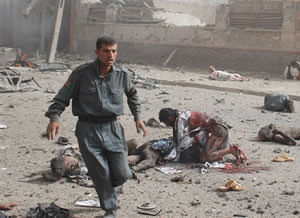
Details have emerged about Monday’s deadly blast at the Indian Embassy in Kabul, Afghanistan, raising suspicions that the bombing was done by Pakistani militants associated with the Taliban. The fact that the Indian Embassy was targeted is one substantial indication, considering the long-standing conflict between India and Pakistan. However, Taliban spokesman Zabiullah Mujahed denied that his organization was responsible for the attack. The blast killed 41 and injured over 130.
Your support is crucial...The New York Times:
India said it would send a delegation to Pakistan to investigate what the Indian Foreign Ministry called “this cowardly terrorist attack.”
Afghan and Western officials have said a recent spate of sophisticated, deadly attacks show the growing influence of Al Qaeda and other foreign terrorists over Pakistani militants in the tribal areas, and possibly alliances between them. Part of the insurgent strategy has been to carry out suicide bomb attacks in the cities.
Suicide bombers attacked the five-star Serena Hotel in Kabul in January and mounted a sophisticated assassination attempt on President Karzai during a military parade in April, an attack that Afghan intelligence linked directly to Pakistan’s premier intelligence agency, Inter-Services Intelligence.
Pakistani intelligence has long supported militant groups fighting in Kashmir and Afghanistan as a means to influence regions on its borders and, according to some Western diplomats and military officials, they maintain those links today, including with some elements of the Taliban. The choice of an Indian target raised further suspicions among officials here about the possible influence of Pakistani intelligence, since Pakistan has had fraught relations with India for decades.
As we navigate an uncertain 2025, with a new administration questioning press freedoms, the risks are clear: our ability to report freely is under threat.
Your tax-deductible donation enables us to dig deeper, delivering fearless investigative reporting and analysis that exposes the reality beneath the headlines — without compromise.
Now is the time to take action. Stand with our courageous journalists. Donate today to protect a free press, uphold democracy and uncover the stories that need to be told.
 Middle East
What some in Joe Biden's administration appear to see as an opportunity to sideline Hezbollah is really a trap destined for failure.
Middle East
What some in Joe Biden's administration appear to see as an opportunity to sideline Hezbollah is really a trap destined for failure.
 TD Interview
A new book offers a personal and political history of Bush-era America and its imprints on the present.
TD Interview
A new book offers a personal and political history of Bush-era America and its imprints on the present.
 Film
With unprecedented access to the Taliban, the documentary “Hollywoodgate” makes promises it can’t keep.
Film
With unprecedented access to the Taliban, the documentary “Hollywoodgate” makes promises it can’t keep.
 Wounds of War
Over the decades, the DoD has been responsible for the deaths of scores of civilians, but compensating those harmed has never been a serious priority.
Wounds of War
Over the decades, the DoD has been responsible for the deaths of scores of civilians, but compensating those harmed has never been a serious priority.
 Opinion
Where’s the headline-making outrage over the never-ending travesty of Gitmo?
Opinion
Where’s the headline-making outrage over the never-ending travesty of Gitmo?
 Opinion
We both have the same enemies but spend most of the time ignoring that fact.
Opinion
We both have the same enemies but spend most of the time ignoring that fact.
You need to be a supporter to comment.
There are currently no responses to this article.
Be the first to respond.