Is Tanning Addictive?
By now, we all ought to be aware that making like Tater Tots and browning ourselves, whether the natural way or on tanning beds, isn't a recipe for optimal health. So why do some people still do it, sometimes to excess? Turns out aesthetics may not fully explain the tanning phenomenon.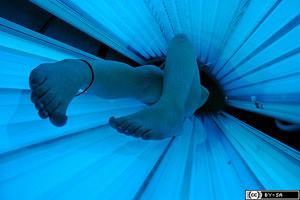
By now, we all ought to be aware that making like Tater Tots and browning ourselves, whether the natural way or on tanning beds, isn’t a recipe for optimal health. So why do some people still do it, sometimes to excess? Turns out aesthetics may not fully explain the tanning phenomenon. –KA
Your support matters…Los Angeles Times:
As many as a third of young people who use indoor tanning facilities may be addicted to the behavior, researchers reported Monday. The findings are the latest to suggest that tanning, whether natural or indoors, activates the same parts of the brain triggered by drug dependence.
The study screened college students using two standard questionnaires designed to assess addiction and modified to assess tanning behavior. Among 229 people who said they had used indoor tanning facilities in the past, 39% met one measure’s criteria for addiction; 30% met the other measure’s criteria.
The tanners were aware that repeated exposure to ultraviolet light, either indoors or outside, increases the risk of several types of skin cancer, including the most dangerous type, melanoma, said the study’s lead author, Catherine E. Mosher, a post-doctoral research fellow in psychiatry and behavioral science at Memorial Sloan-Kettering Cancer Center in New York.
Independent journalism is under threat and overshadowed by heavily funded mainstream media.
You can help level the playing field. Become a member.
Your tax-deductible contribution keeps us digging beneath the headlines to give you thought-provoking, investigative reporting and analysis that unearths what's really happening- without compromise.
Give today to support our courageous, independent journalists.
 Health & Wellness
The University of California’s Opioid Industry Documents Archive opens new windows onto the institutional sociopathy behind the opioid crisis.
Health & Wellness
The University of California’s Opioid Industry Documents Archive opens new windows onto the institutional sociopathy behind the opioid crisis.
 Health & Wellness
Current regulation of safer nicotine products like vapes is based on politics, not science. It’s costing lives.
Health & Wellness
Current regulation of safer nicotine products like vapes is based on politics, not science. It’s costing lives.
 Book Excerpt
Decades before it gripped communities across the United States, the roots of the opioid epidemic began with shifting ideas about palliative care among medical professionals.
Book Excerpt
Decades before it gripped communities across the United States, the roots of the opioid epidemic began with shifting ideas about palliative care among medical professionals.
 Film
Laura Poitras sacks the Sacklers with an ode to activism.
Film
Laura Poitras sacks the Sacklers with an ode to activism.
 She was in her 20s when the book chronicling her addiction and depression was published, igniting a debate that lasted for much of her life.
 The pharmaceutical executives behind the opioid crisis could learn a thing or two from people in recovery from drug addiction.
You need to be a supporter to comment.
There are currently no responses to this article.
Be the first to respond.