Halliburton Blamed for Shoddy Construction in Gulf Oil Disaster
Three of four tests showed that the cement mixture used by Halliburton in the construction of BP's ill-fated oil well in the Gulf was unstable, but the mixture was used anyway, a presidential commission investigating the disaster has found. The only successful test, which BP did not know about, has since come under suspicion.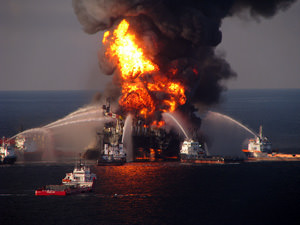
Three of four tests showed that the cement mixture used by Halliburton in the construction of BP’s ill-fated oil well in the Gulf was unstable, but the mixture was used anyway, a presidential commission investigating the disaster has found. The only successful test, which BP did not know about, has since come under suspicion.
Your support matters…AP via Google:
The panel said that of four tests done in February and April by Halliburton, only one — the last — showed the mix would hold. But the results of that single successful test were not shared with BP, and may not have reached Halliburton, before the cement was pumped, according to a letter sent to commissioners Thursday by chief investigative counsel Fred H. Bartlit Jr.
BP had in hand at the time of the blowout the results of only one of the tests — a February analysis sent to BP by Halliburton in a March 8 e-mail that indicated the cement could fail. The slurry tested in that case was a slightly different blend, and assumed a slightly different well design, but there is no indication that Halliburton flagged the problem for BP, or that BP had concerns, the letter said.
[…] Independent tests conducted for the commission by Chevron on a nearly identical mixture were also released Thursday. The results concluded that the cement mix was unstable, raising questions about the validity of Halliburton’s final test.
Independent journalism is under threat and overshadowed by heavily funded mainstream media.
You can help level the playing field. Become a member.
Your tax-deductible contribution keeps us digging beneath the headlines to give you thought-provoking, investigative reporting and analysis that unearths what's really happening- without compromise.
Give today to support our courageous, independent journalists.
 With his reelection at stake, Barack Obama made a series of decisions to control the disaster. It's clear now just how calamitous they were.
 A new probe finds Louisiana has failed to pursue millions in remediation for spills—money environmental groups say they desperately need.
 A batch of corporate boards filled with sociopaths are knowingly killing us all. But one thing could end their murderous streak.
 In a congressional district where voters rely on fossil-fuel jobs, it’s not easy, but it's absolutely essential.
 A new investigation finds a range of industries were able to successfully mask their sponsorship of political ads on the social network.
It’s been going on since 2004, with no end in sight.
A new investigation finds a range of industries were able to successfully mask their sponsorship of political ads on the social network.
It’s been going on since 2004, with no end in sight.
You need to be a supporter to comment.
There are currently no responses to this article.
Be the first to respond.