Google Exec Knows About Unemployment
Quiz time: According to Google CEO Eric Schmidt, which social phenomenon is most to blame for the present jobs crisis? (A) globalization (B) technology and innovation (C) disproportionate taxation resulting in the wildly uneven distribution of wealth and a lean demand for workers.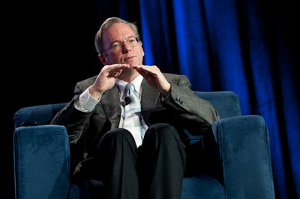
Quiz time: According to Google CEO Eric Schmidt, which social phenomenon is most to blame for the present jobs crisis? (A) globalization (B) technology and innovation (C) disproportionate taxation resulting in the wildly uneven distribution of wealth and a lean demand for workers.
None of the above, it turns out. In late January at the World Economics Forum in Davos, Switzerland, the Internet executive told fellow members of the 1 percent that it was the lack of will by industrial nations to invest in the education and training of its workers.
Peter Goodman, business editor of The Huffington Post, begs to differ. –ARK
Your support matters…Peter S. Goodman at The Huffington Post:
Schmidt too blithely dismissed a problem with no easy answers, one at the center of the populist ferment now seething from Cairo to Columbus. In the United States, he suggested, unemployment is predominantly the result of inadequate skills among the workforce, a problem that could be addressed with better education.
“Governments have to do something that’s hard,” he said. “They have to go back and invest in human capital. There are plenty of companies in the U.S. and other countries I’ve visited that are very short of highly skilled workers.”
… For an individual, gaining education as an approach to increasing work opportunities is a no-brainer. But for society as a whole, the employment shortage cannot be eliminated in this fashion because of a feature that Schmidt seemed uninterested in addressing: The benefits of technological progress and automation are being spread unevenly, exacerbating the forces of inequality that have left millions of formerly hard-working people unable to pay their bills.
Independent journalism is under threat and overshadowed by heavily funded mainstream media.
You can help level the playing field. Become a member.
Your tax-deductible contribution keeps us digging beneath the headlines to give you thought-provoking, investigative reporting and analysis that unearths what's really happening- without compromise.
Give today to support our courageous, independent journalists.
 Editorial Cartoons
 Editorial Cartoons
 Editorial Cartoons
 Courts & Law
A decision looms on whether Idaho’s abortion ban would allow persecution of doctors who terminated a pregnancy during a health emergency.
Courts & Law
A decision looms on whether Idaho’s abortion ban would allow persecution of doctors who terminated a pregnancy during a health emergency.
 Opinion
The Columbia professor’s legacy is a scathing condemnation of the hypocrisy and moral corruption of U.S. liberal institutions.
Opinion
The Columbia professor’s legacy is a scathing condemnation of the hypocrisy and moral corruption of U.S. liberal institutions.
 TD Original
Hydropower projects are far from climate neutral and the downstream threats to indigenous sovereignty, biodiversity and marine ecosystems are significant and growing.
TD Original
Hydropower projects are far from climate neutral and the downstream threats to indigenous sovereignty, biodiversity and marine ecosystems are significant and growing.
You need to be a supporter to comment.
There are currently no responses to this article.
Be the first to respond.