|
|
|
|
|
|
|
|
|
|
|
|
|
|
|
|
|
|
By Orville Schell (Foreword), Wayne Miller
By Dave Eggers $25.00
$19
|
|
|
|
|
By William Pfaff — The military is far too accustomed to getting its way, so it was refreshing to see Barack Obama reject the Pentagon’s sluggish withdrawal plan. But will he stand up to Israel, whose Prime Minister Olmert recently bragged about pulling the American president’s puppet strings?
|
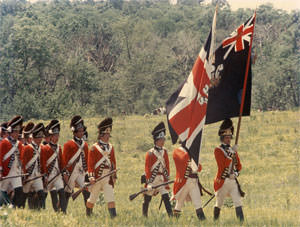
 americaslibrary.gov
|
The British Defense Ministry has leaked news that it will begin a phased troop withdrawal from Iraq. The drawdown will bring to an end a torrid, near-six-year love affair with the U.S. that began with coordinated intelligence failures and eventually led to jointly invading a sovereign country under cover of a “war on terror.”
|
 USAF / Staff Sgt. Samuel Rogers
|
By William Pfaff — Barack Obama has no choice but to accept responsibility for America’s foreign policy crises. But why should he accept them on the distorted and even hysterical terms by which the Bush administration has defined world affairs since 2001?
|
 whitehouse.gov
|
We tearfully regret to inform you that an agreement that would legally extend the U.S. imperial occupation of Iraq is at risk of falling apart, as Iraqi officials continue to make the audacious demand that U.S. soldiers and mercenaries be subject to Iraqi law for crimes committed outside the scope of military operations.
|
|
By Eugene Robinson — It’s not a “timetable” for extricating U.S troops from Iraq that George W. Bush is suddenly talking about, and heaven help anyone who accuses him of proposing a “timeline.” No, the Decider says he is now amenable to a “time horizon,” which apparently is a whole different kind of time thing.
|
 AP photo / Hadi Mizban
|
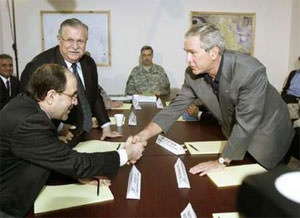
In what The New York Times is calling a “significant concession,” President Bush allowed the topic of U.S. troop withdrawal from Iraq to enter a discussion about America’s long-term strategy in the region. This occurred Thursday during a video conference with Iraqi Prime Minister Nouri al-Maliki.
|
|
By David Sirota — In the asylum that is American politics, beware a candidate like Barack Obama when he is lauded for moving to “the center”—because usually that means he is drifting away from it.
|
|
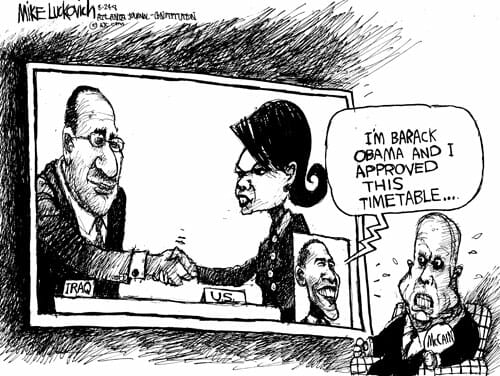
President Bush had hoped to shape America’s military presence in Iraq for years after his departure from the White House by negotiating a long-term status-of-forces agreement, but a number of sticking points indicate there will be a much shorter time frame. U.S. negotiators have agreed to a kind of timetable for withdrawal, as demanded by the Iraqis, but are holding out over legal immunity for American forces.
|
 AP photo / Duane A. Laverty
|
Despite some congressional resistance, it seems Gen. David Petraeus’ recommended “pause” in U.S. troop withdrawals from Iraq will take effect after July. On Thursday, President Bush (whose approval ratings have plummeted to a new low) essentially deferred the withdrawal issue to his successor.
|

|
There were some heated exchanges in Wednesday’s debate between the Republican candidates. John McCain and Mitt Romney argued about who wanted to stay in Iraq longer and Ron Paul won a round of applause when he said the front-runners were bickering over “technicalities” while their war bankrupts the country.
|
 AP Photo / Evan Vucci
|
President Bush attempted to exercise spin control to smooth over his relationship with Iraqi Prime Minister Nouri al-Maliki on Wednesday, emphasizing the Iraqi people’s claim on their own government after his comments a day before seemed to signal his displeasure with Maliki’s leadership.
|
|
The Iraqi prime minster is now under attack from leading U.S. politicians. Even President Bush is distancing himself. As Nouri al-Maliki turns to find “friends elsewhere”—in Syria, which he is visiting, and in Iran, with which he has close ties—will he come to be viewed as yet another monster we created?
|
|
By E.J. Dionne, Jr. — The veteran political observer argues that the Democrats’ retreat on the war spending bill is but a temporary setback in a much longer struggle they are sure to win, if only opponents of the war are patient, determined and ready for the next fight.
|
|
The Democratic leadership in Congress is close to a deal with the White House to provide funding for the war without a timetable for withdrawal. The legislation will include benchmarks for U.S. aid, close to $8 billion in domestic spending and a minimum-wage increase, but House Speaker Nancy Pelosi has indicated that she cannot bring herself to vote for a bill that doesn’t set a withdrawal date for U.S. troops.
|
|
Iraqi Defense Minister Abdul-Qader al-Obeidi revealed Monday that his government is planning for a rapid pullout of American forces: “The army plans on the basis of a worst-case scenario so as not to allow any security vacuum. ... There are meetings with political leaders on how we can deal with a sudden pullout.”
|
|
A delegation of 11 moderate House Republicans visited the White House on Tuesday to warn the president that he risks losing more support from his party if conditions in Iraq do not improve by fall. The lawmakers lamented dwindling support for the war among their constituencies during the meeting, which was described as “no-holds-barred.”
|
|
While the Bush administration has repeatedly referred to the Democrats’ timetable for withdrawal from Iraq as a recipe for failure, Defense Secretary Robert Gates has praised the measure. He’s also urged an assessment of the troop escalation by this summer—sooner than supporters of the “surge” would like—and indicated support for a withdrawal as outlined by the Iraq Study Group, which he was once a part of.
|
|
President Bush is set to meet with members of Congress on Wednesday to try to work out a compromise on the Iraq spending bill. It’s not clear what they could possibly agree on, since Bush has said he won’t sign any legislation that calls for a withdrawal, and the essentially nonbinding timetable in the last measure was basically the least the Democrats could do to signal their opposition to the war.
|
|
By Jeremy Scahill — The author of “Blackwater: The Rise of the World’s Most Powerful Mercenary Army” argues that the Democrats’ withdrawal plan—even if it ever gets past a veto—isn’t anything to write home about.
|
|
By E.J. Dionne, Jr. — President Bush and Vice President Cheney cannot make the case that their Iraq policies have succeeded, so they are doing one thing they do very well: taking a serious argument over the future of American foreign policy and turning it into a petty partisan squabble.
|
|
The House has voted 218 to 208 to approve a withdrawal timetable for Iraq, with a pullout set to begin by Oct. 1. The Senate is expected to pass its version of the bill Thursday, sending the measure to President Bush for his inevitable veto.
|
 inthesetimes.com
|
According to a new Washington Post-ABC News poll, 58 percent of Americans trust congressional Democrats to do a better job of setting policy for the Iraq war than the president. An overwhelming majority, however, disapprove of the job both branches of government have done so far.
|
|
The president has threatened to veto a war spending bill that includes a timetable for the withdrawal of troops, but that didn’t stop the Senate on Thursday from passing one. The next step is for the House and Senate to work out the differences between their competing withdrawal plans, and then it’s off to the White House.
|
|
With Congress nearing a consensus on a withdrawal timetable, the president repeated the claim Wednesday that Democrats would be held responsible for denying the troops funding. House Speaker Nancy Pelosi responded by saying Bush should “Calm down with the threats,” and Senate Majority Leader Harry Reid simply asked, “Why doesn’t he get real with what’s going on with the world?”
|
 washtimes.com
|
The Senate narrowly defeated a Republican amendment Tuesday that would have removed a withdrawal plan from the emergency war spending bill. As the legislation stands, the U.S. will have to begin a troop withdrawal within four months after the law is enacted and complete the pullout by March 31, 2008.
|
|
The House of Representatives narrowly passed the hotly debated timeline for getting American troops out of Iraq by Aug. 31, 2008. Bush has indicated he will veto the bill. In a statement to the press, House Speaker Nancy Pelosi said: “The American people see the reality of war. The president does not.”
|
 boston.com
|
Despite the threat of a veto, withdrawal legislation moved forward in the House Thursday. Meanwhile, in the Senate, a weaker measure was successfully opposed by all but one Republican, two Democrats and Joe Lieberman.
|
|
The Democratic leadership in the House hopes to attach a timetable for withdrawal to an upcoming Iraq war spending bill. The most ardent war opponents have expressed dissatisfaction that the language is not unconditional, but Rep. John Murtha, D-Pa., a prominent withdrawal advocate, said “you’ll see basically what I wanted to do….”
|
 AP Photo / Seth Wenig
|
Presidential contender Barack Obama has gotten serious about Iraq after months of public speculation on where he stands. The senator offered legislation Tuesday night that would set a deadline of March 31, 2008, for the withdrawal of all combat brigades from Iraq.
|
 From CNN via ThinkProgress
|
The dangerously out-of-touch secretary of defense bristled at reporters’ attempts to challenge him on differences between U.S. and Iraqi officials on benchmarks for progress in Iraq.
UPDATE: Watch it
|
 house.gov
|
Whether it’s because he’s facing a tough campaign against an antiwar Democrat or he just lost his supply of kool-aid, Christopher Shays (R-Conn.) has swung ‘round to sanity on the Iraq war. After returning from his 14th visit to Iraq, the once-steadfast hawk called for a timetable for withdrawal and bashed Rumsfeld: “I haven’t had faith in the secretary in a long time.”
|
|
The Iraqi prime minister is set to unveil a national reconciliation plan that includes amnesty for insurgents, a timetable for withdrawal of allied forces, release of security detainees from U.S. and Iraqi prisons and compensation for some victims of coalition military operations.
|
|
By Andy Borowitz — The satirist reports that Sen. Kerry’s words may have fallen on deaf ears at the White House, where President Bush vowed to remain in Iraq “until we have determined why we are there.”
|
View the most popular tags overall?
|
|