Study: IMF Austerity Helped Ebola Kill Nearly 8,000 People
Professors at three leading British universities say International Monetary Fund policies favoring the repayment of international debts over social welfare spending contributed to the Ebola crisis by inhibiting an effective response by health care professionals in the three worst-hit African countries.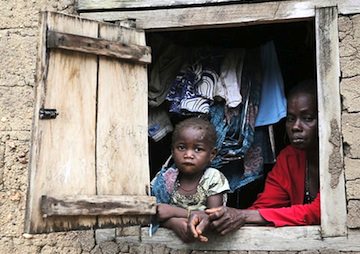 Children in the town of Gueckedou, reported to be the epicenter of the Ebola outbreak in Guinea. Photo by EU Humanitarian Aid and Civil Protection (CC BY-ND 2.0)
Professors at three leading British universities say International Monetary Fund policies favoring the repayment of international debts over social welfare spending contributed to the Ebola crisis by inhibiting an effective response by health care professionals in the three worst-hit African countries.
Reports Michelle Faul at The Huffington Post:
Conditions for loans from the IMF prevented an effective response to the outbreak that has killed nearly 8,000 people, the academics allege in a report in The Lancet Global Health journal this month.
… “The IMF aims to become part of the solution to the crisis … Yet, could it be that the IMF had contributed to the circumstances that enabled the crisis to arise in the first place?” asks the study, whose lead author is Cambridge University sociologist Alexander Kentikelenis. Co-authors are Lawrence King of Cambridge, Martin McKee of the London School of Hygiene and Tropical Medicine and David Stuckler of Oxford University.
IMF lending requires governments to give priority to short-term economic objectives over investment in health, the authors said, citing IMF statistics that showed the terms of loans to Guinea, under an IMF austerity program for 21 years, Liberia, following one for seven years, and Sierra Leone, in one for 19 years.
The report further said that IMF policies contributed to “under-funded, insufficiently staffed, and poorly prepared health systems” in the three countries, which enabled the outbreak to spread so rapidly. The organization’s insistence on decentralized health care made mobilizing a coordinated response to Ebola more difficult than it could have been.
— Posted by Alexander Reed Kelly.
Your support matters…Independent journalism is under threat and overshadowed by heavily funded mainstream media.
You can help level the playing field. Become a member.
Your tax-deductible contribution keeps us digging beneath the headlines to give you thought-provoking, investigative reporting and analysis that unearths what's really happening- without compromise.
Give today to support our courageous, independent journalists.
 TD Original
An historic progressive coalition looks to change the course of politics on the island.
TD Original
An historic progressive coalition looks to change the course of politics on the island.
 Social Justice
As many as 70,000 child care centers are projected to close in the next several months as pandemic-era federal funding ends, pushing an industry already in crisis to a breaking point.
Social Justice
As many as 70,000 child care centers are projected to close in the next several months as pandemic-era federal funding ends, pushing an industry already in crisis to a breaking point.
 The budget proposal offers a terrifying preview of what we can expect from Trump if he wins another four years in office.
 The former mayor of South Bend, Indiana, draws fire for claiming it's "not fashionable in progressive circles" to talk about the deficit.
 Iraqis are demanding an end to corruption and sectarianism, while also objecting U.S. troops and Iranian influence.
 From Chile to Iraq, popular uprisings against austerity and corruption are spreading like wildfire at a crucial point in history.
You need to be a supporter to comment.
There are currently no responses to this article.
Be the first to respond.