
NAFTA Partners Meet to Negotiate TPP Deal
The Trans-Pacific Partnership is like NAFTA on steroids, so it makes some sense that Canada, the United States and Mexico hope to fix the old, ostensibly bad trade deal with another, bigger one.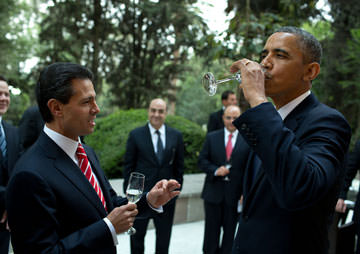 President Obama tastes a sip of tequila at the urging of Mexican President Enrique Peña Nieto in Mexico City in May. (White House/Pete Souza)
The Trans-Pacific Partnership is like NAFTA on steroids, so it makes some sense that Canada, the United States and Mexico hope to fix the old, ostensibly bad trade deal with another, bigger one.
President Barack Obama, his Mexican counterpart, President Enrique Peña Nieto, and Prime Minister Stephen Harper of Canada are all in Toluca, Mexico, on Wednesday to hash out the details.
Among those not invited to the meeting, there is concern that the new deal could be even worse than NAFTA.
Mexicans, for instance, have good reason to fear the devouring by foreign interests of the national oil company PEMEX, and Americans, already struggling to compete with globalized manufacturing, fear the loss of jobs. Everyone has cause to be concerned about environmental impacts and questions of national sovereignty — the TPP would reportedly supersede local labor and business laws.
The Christian Science Monitor:
Perhaps the biggest challenge for the North American leaders is winning their populations over to TPP’s vision of a broadened trade agreement.
If the leaders take a break from their discussions to listen to what’s going on beyond the walls around them, they may hear the chants of protesters who aim to derail any expansion of NAFTA.
Obama, too, faces stiff resistance at home from trade-pact opponents – concentrated largely in his own Democratic Party. If a free-trade agreement with Mexico was bad for American workers, as some companies moved south of the border where labor was cheaper, they say, how much worse will a pact be that includes the likes of Vietnam?
— Posted by Peter Z. Scheer
Your support matters…Independent journalism is under threat and overshadowed by heavily funded mainstream media.
You can help level the playing field. Become a member.
Your tax-deductible contribution keeps us digging beneath the headlines to give you thought-provoking, investigative reporting and analysis that unearths what's really happening- without compromise.
Give today to support our courageous, independent journalists.
 TD Original
Reflecting on the systems that maintain racism and separatism in America.
TD Original
Reflecting on the systems that maintain racism and separatism in America.
 Wounds of War
According to Pentagon policy on “responding to civilian harm”, Defense Secretary Lloyd Austin owes Somalian drone victims an overdue apology.
Wounds of War
According to Pentagon policy on “responding to civilian harm”, Defense Secretary Lloyd Austin owes Somalian drone victims an overdue apology.
 Editorial Cartoons
 Politics
Obama's only takeaway from the Syria episode was to never again seek Congressional approval for military action.
Politics
Obama's only takeaway from the Syria episode was to never again seek Congressional approval for military action.
 Politics
Cautionary politics lost them the majority a decade ago. It’s taken that long to reboot.
Politics
Cautionary politics lost them the majority a decade ago. It’s taken that long to reboot.
 With his nonstop barrage of lies, the president has degraded our electoral system to the point that any result will feel illegitimate.


You need to be a supporter to comment.
There are currently no responses to this article.
Be the first to respond.