Hong Kong Protesters Say They Aren’t Going Anywhere
Thousands returned to occupy Hong Kong's Central district Friday after the government backed out of talks and threatened to break up the demonstrations.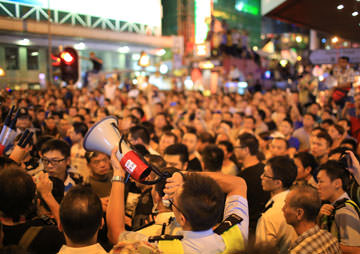 Protesters in Hong Kong on Oct. 1. Lewis Tse Pui Lung / Shutterstock.com
Thousands returned to occupy Hong Kong’s Central district Friday after the government backed out of talks and threatened to break up the demonstrations.
One student, quoted by Reuters, said, “I’ve just set up camp here under the bridge and I will come down to occupy whenever I can. … I may have to go back to school during the day, but I will make every effort to come back.”
Protesters want the freedom to select their own candidates rather than choosing from a slate handpicked by Beijing. They’re also asking for Hong Kong’s administrator, Leung Chun-ying, to resign.
Hong Kong is considered a “special administrative region” of the People’s Republic of China, meaning it has different rules than the rest of the country. Actually, China maintains numerous jurisdictions with varying rules. But Hong Kong is special. Formerly occupied by the British, China regained control of the island and its mainland territory in 1997 and planned a smooth, deliberate transition over 50 years. The protesters maintain that Beijing had, from the beginning, promised to maintain democratic principles. Actually, British rule wasn’t so democratic, either. Nonetheless, the people of the fragrant island want more.
The location of the protests is key. Hong Kong has a diverse population, though mostly Chinese, but Central is where all the bankers and Europeans work and play. It’s where you would go to see white faces and expensive cars, and its pristine streets are littered with towering skyscrapers. Central is very much the Wall Street (with the rest of Manhattan dropped on top) of Hong Kong, and this movement, although indigenous, seems to resemble Occupy in that regard.
— Posted by Peter Z. Scheer
Your support matters…Independent journalism is under threat and overshadowed by heavily funded mainstream media.
You can help level the playing field. Become a member.
Your tax-deductible contribution keeps us digging beneath the headlines to give you thought-provoking, investigative reporting and analysis that unearths what's really happening- without compromise.
Give today to support our courageous, independent journalists.
 Economic Justice
The tax credits are too complicated and trade warriors are blocking cheaper Chinese models.
Economic Justice
The tax credits are too complicated and trade warriors are blocking cheaper Chinese models.
 Asia Pacific
Biden envoy, Joseph Yun, helped shape defensive policy for the Pacific islands while consulting for a private firm that represents a massive conflict of interest.
Asia Pacific
Biden envoy, Joseph Yun, helped shape defensive policy for the Pacific islands while consulting for a private firm that represents a massive conflict of interest.
 Asia Pacific
The celebration of a "categorical leap” in Japanese rearmament risks inflaming tensions in the Pacific.
Asia Pacific
The celebration of a "categorical leap” in Japanese rearmament risks inflaming tensions in the Pacific.
 Politics
We should actively pursue policies in the national interest, not intentionally inflame tensions at the expense of international cooperation.
Politics
We should actively pursue policies in the national interest, not intentionally inflame tensions at the expense of international cooperation.
 Editorial Cartoons
 Technology
The recent push to effectively ban TikTok has little to do with security concerns and everything to do with a neo-McCarthyite view of China.
Technology
The recent push to effectively ban TikTok has little to do with security concerns and everything to do with a neo-McCarthyite view of China.
You need to be a supporter to comment.
There are currently no responses to this article.
Be the first to respond.