Jun 23, 2017

Borders of Love, Borders of War

Rooted in Truth.
Independent by Design.

Your support helps ensure that rigorous reporting, thoughtful analysis, and investigative journalism remain accessible to everyone.

Support our independent journalism.

SUPPORT TRUTHDIG
Conversations (0)

You need to be a supporter to comment.

There are currently no responses to this article.
Be the first to respond.

Jan 5, 2016

Borders of Love, Borders of War

In a Turkish city near the Syrian conflict zone, an ancient tide of passions—both human and political—moves millions. In a Turkish city near the Syrian conflict zone, an ancient tide of passions—both human and political—moves millions.
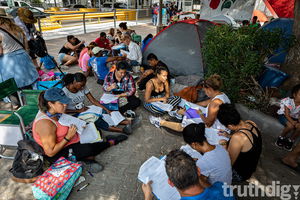
Syrian refugees in Gaziantep, Turkey. (Amie Williams) 1 2 3
Like an alphabet soup, the dizzying array of acronyms and abbreviations for the Kurdish militia, terrorist and Islamist militant groups headquartered here is difficult to keep straight, let alone understand. A Gaziantep journalist drew a map for me in my journal, outlining the following: YPG-YPJ, Al-Nusra, Ahrar al-Sham, ISIS, Cey? El Siwar, OSO and PKK. He works for a local Kurdish publication and has been across the border more times than he can remember. He asked me not to use his name since the Turkish authorities have detained him before. His fully bearded face and midnight-black mustache seemed incongruous with his habit of bursting into laughter. His sparkling, playful eyes kept looking at me with pity, as if I would never understand what he was trying to explain. Certainly this region of Turkey, steeped in a historical narrative of struggle, tragedy and loss, may be just that—an ongoing, obdurate enigma. At a local cafe in the historic Jewish-Armenian part of town, a warren of narrow cobblestone streets and quaint courtyard cafes, we listen to a young woman playing the baglama and singing a sad Kurdish love song, a paperback biography of Che Guevara by her side. Someone had scrawled on the wall: “He asked me, why do you fight when you know you can’t win, and because I did not want to upset him, I did not respond by saying, why do you live, when you know you will die?” Elsewhere hung portraits of Kurdish poets and rebels, and the place was packed with cigarette-smoking students from Gaziantep University, one of the top engineering schools in Turkey. One of them is our guide, Memed Akif. “People are politicized very early here,” he explains. Raised on a diet of Kurdish-identity consciousness and an impatience with the slow pace of promised democratic reforms, most young Turks I speak with here reject the outcome of the elections as yet another indication of Turkish President Recep Tayyip Erdogan’s iron grip on the throat of their nation. But even Akif, a tall, muscular Ph.D. candidate in economics, has a sweetness and quietude that immediately puts me at ease. I asked him what his dreams are for the future. He doesn’t get me at first. “For my country or for me?” he gently asks. It’s as if he doesn’t know how to think about himself. Although nightly news reports focus on the steady stream of Syrian refugees to Europe, there are more than 1.8 million refugees in Turkey. An unofficial 500,000 of these are in Gaziantep, according to our Kurdish journalist, most of them recent arrivals from Aleppo. Exploring the back streets, I see a Syrian girl, no more than 6 years old, playing “teacher” to her three younger brothers in a make-believe school. They sit attentively on concrete blocks, eagerly raising their hands as she reads from a torn notebook. Many Syrian refugee children here, due to language barriers and bureaucracy, do not have the luxury of attending school. In another alley, we meet a large family from Aleppo, who told us they have been basically homeless for two years. Three generations of women squat against a crumbling stone wall, while the brothers break up scraps of particle wood for fire and the father tries to connect loose wires in a vain attempt at pirating electricity. Back at the cafe, I take a short video of the girl singing, the haunting lyrics a perfect soundtrack for musings on my script—a true story of two sisters torn apart by Islamic State. I will call them Leila and Essma for reasons of anonymity. Both spent time in this town, on their way crossing borders, changing lives. Walking through the narrow, cream-brick alleyways where the Armenians used to live, I feel the ghosts of this town, continually retracing its trope as tragic backdrop to larger international struggles. We stumble on a small film crew that morning, filming a local soap opera. Gulnaz tells me that another popular Turkish TV show, “Yabanc? Damat” (literally “The Foreign Groom”), was shot here. It’s a love story of a Turkish man and a Greek woman, and is also known in Greece as “The Borders of Love.” I have been struggling to understand why Leila, the younger of the two Tunisian sisters, left the relative safety and comfort of her middle-class home in Tunis, crossing through Turkey to Syria to join her husband. She was a typical teenager in many ways, into sports and even hip-hop. Her older sister Essma tells me she was in love, only 19 and very naive. She was also pregnant. In Tunisian society, having sex before marriage is still a huge taboo, so it’s not a big stretch to sympathize with this girl’s reasoning and limited choices. The resounding stereotype of a young woman traveling to Syria to join the Islamic State has been that of a docile girl being lured through social media by a seductive male. But through my research, I am finding the motivations of many of these women to be varied and far more complex. Earlier this year in London, I met with Erin Saltman, a senior researcher at the Institute for Strategic Dialogue and contributor to “Becoming Mulan?: Female Western Migrants to ISIS.” She and her fellow researchers combed through the social media accounts of women who lived in Islamic State-controlled territory, finding that it was often women who attracted and recruited other young women. One particularly compelling Tumblr page I read before it disappeared, “Diary of a Muhajirah” (muhajirah means “one who leaves something”), speaks of joining a utopian sisterhood, far from the cruel, cliquish realities so many teenage girls must survive in Western schools and society. Saltman’s study also revealed how these women feel a deep compassion for Syria’s war victims, citing the oppression of Muslims worldwide. They are attracted by the idea of building a new life, contributing to a grand cause. The online messages also warn them to come prepared: “To live a completely different kind of life means completely changing your outlook on life and researching as much as you want until you feel content with what you are about to do and know it is right,” one muhajirah wrote in her blog. Essma did make it across the border to Raqqa to find Leila and try to convince her to return home. She told me about the locked-down life she witnessed there, with her sister reduced to raising her child and cooking most of the day because there was nothing else to do. Women were rarely let out of their homes or seen on the streets, she told me. Leila busied herself with domestic chores and child rearing, venturing out to meet with other young Islamic State brides only occasionally, to share cake recipes and sip tea at the town’s madhafa, or females’ hostel. I asked Essma how she managed to leave Raqqa and return to Tunis, given the tight grip Islamic State commanders had on the town. She shrugged, “It was easy, normal.” There were many informal transports for Syrian refugees and a steady stream of underground trade in such items as petrol, cigarettes and drugs. She kept repeating that word over and over, “normal.” What I sensed she was doing was internalizing, like her sister, a deeper discomfort at not being able to speak about the unspeakable, or to admit a major mistake had been made. It’s not unlike the post-traumatic stress disorder I witnessed in American female combat soldiers who fought in the Iraq War, and who masked their deep disillusionment with joining a cause they largely miscalculated. It’s also a sentiment I hear echoed in so many women I’ve interviewed over the years who have been raped, battered or abused. For anyone who has been in an addictive relationship or rationalized being trapped in a violent one, the line between insanity and passion can easily blur. Add religion or the search for spiritual relief to the mix and you stumble into territory that is understandably murky, but unfortunately all too common for women. Over strong Turkish coffee, Gulnaz tells me, “Turkey is a melancholy country—my Kurdish father used to stare out the window at the mountains and cry.” Unlike her father, she is the perfect, upbeat travel companion. Married to a Briton and living in London for the past year, she’s falling in love with her country all over again. We laugh a lot at the way the mainstream media so often misses the nuances of life lived on the edges of conflict, and how the word “Islam” so often appears in the same sentence as the word “terrorist.” Even our own friends and families were appalled at our travel plans. The fact is, most of the more than 2 million people living in Gaziantep go about their daily business normally—working, drinking coffee, selling SIM cards and, yes, even falling in love. We walk through the small bazaar here, combing through piles of kutnu—the shiny, striped fabric that Gaziantep is famous for. The proud shopkeeper tells us the silk has been painstakingly woven by hand on wooden frames here for centuries. He shows us a grainy video on his laptop, perched precariously atop a towering pile of the fabric, in which a Gaziantep designer is being interviewed during Fashion Week in London, showing off miniskirts and dresses made from the cloth. Somehow, seeing miniskirts on the emaciated bodies of European models—skirts most likely made by the hands of refugee women here—makes me want to scream, a reaction I am sure the earnest shopkeeper would not appreciate. We spend the afternoon interviewing a young female politician, Berivan Özpolat, who heads up the local chapter of the DBP, the pro-Kurdish feminist party affiliated with the larger Peace and Democracy Party (BDP). The entrance is concealed, around the back of a nondescript building. Inside, orange plastic chairs are being set up for a meeting and she is in a hurry. As sun streams into her cramped office she talks of how women in Gaziantep have always been exploited, hired as cheap labor in the textile factories and to crack pistachio shells, sitting for hours in inhuman conditions. She calls it “savage capitalism.” The huge influx of female Syrian refugees has only guaranteed that this treatment will continue, if not worsen. One alarming local phenomenon is the selling of Syrian brides to Turkish men, apparently a thriving business, even though the men and women don’t have a common language. Rooted in Truth.
Independent by Design.

Your support helps ensure that rigorous reporting, thoughtful analysis, and investigative journalism remain accessible to everyone.

Support our independent journalism.

SUPPORT TRUTHDIG
Conversations (0)

You need to be a supporter to comment.

There are currently no responses to this article.
Be the first to respond.