Back to the Drawing Board for Disney’s First Black Princess
Disney's popular animated films have been criticized for creating 2-D characters from various non-Western (or non-white Western) cultures, so the Mouse House made an attempt to clear its name by creating a "black princess" character who works as a chambermaid for a bratty white Southern debutante in 1920s New Orleans And that's not the half of it .
Disney’s popular animated films have been criticized for creating 2-D characters from various non-Western (or non-white Western) cultures, so the Mouse House made an attempt to clear its name by creating a “black princess” character who … works as a chambermaid for a bratty white Southern debutante in 1920s New Orleans. And that’s not the half of it: The first version of “The Princess and the Frog” featured a heroine named Maddie who, as The Independent put it, was to be “helped by a voodoo priestess fairy godmother to win the heart of a white prince, after he rescued her from the clutches of a voodoo magician.” Oops.
Now, after some storyline tweaking, the story looks a bit different. Enter Princess Tiana.
Your support matters…The Independent:
Disney’s original storyboard is believed to have been torn up after criticism that the lead character was a clichéd subservient role with echoes of slavery, and whose name sounded too much like “Mammy” – a unwelcome reminder of America’s Deep South before the civil rights movement swept away segregation.
The heroine has been recast as Tiana, a 19-year-old in a country that has never had a monarchy. She is now slated to live “happily ever after” with a handsome fellow who is not black – with leaks suggesting that he will be of Middle Eastern heritage and called Naveen. The race of the villain in the cartoon is reported to have also been revised.
The film studio began making changes a year ago, first to its title, The Frog Princess, which some had interpreted as a slur. Amendments to the plot followed.
Independent journalism is under threat and overshadowed by heavily funded mainstream media.
You can help level the playing field. Become a member.
Your tax-deductible contribution keeps us digging beneath the headlines to give you thought-provoking, investigative reporting and analysis that unearths what's really happening- without compromise.
Give today to support our courageous, independent journalists.
 A new documentary presents a cartoon version of the Marvel Comics storyteller's life.
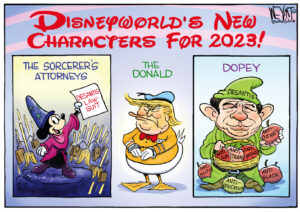 Editorial Cartoons
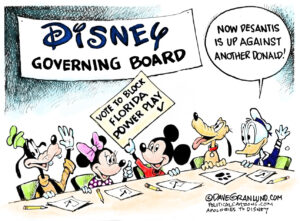 Editorial Cartoons
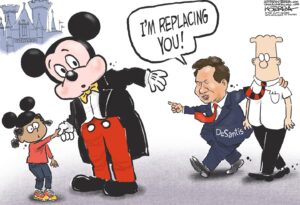 Editorial Cartoons
 The highly favored executive whose pay ranks close to the top among U.S. CEOs will be succeeded by Bob Chapek, the company's parks chief.

You need to be a supporter to comment.
There are currently no responses to this article.
Be the first to respond.