14-Year-Old Was Likely Beaten to Death
Martin Lee Anderson, 14, died a day after he was beaten and dragged by nine guards while in the custody of a juvenile boot camp in Florida The medical examiner initially ruled that Martin died of natural causes, but (h/t: Largest Minority).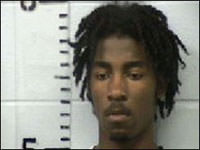
Martin Lee Anderson, 14, died a day after he was beaten and dragged by nine guards while in the custody of a juvenile boot camp in Florida. The medical examiner initially ruled that Martin died of natural causes, but after his parents watched a surveillance tape of the beating, they ordered the body exhumed and asked for a second autopsy, which negated the previous finding.
Your support matters…CBS News:
Martin Lee Anderson was sent to the Bay County Sheriff’s Office boot camp on Jan. 5 for a probation violation. A surveillance video showed guards kicking and punching him after he collapsed while exercising on his first day at the camp, and he died at a hospital early the next day.
The security video shows as many as nine guards kneeing, hitting and dragging Anderson around the exercise yard. The sheriff’s office has said the guards were trying to get Anderson to participate after he became uncooperative.
After seeing the videotape, the boy’s parents agreed to have his body exhumed. They asked Dr. Michael Baden, a noted pathologist who had reviewed medical evidence in the slaying of civil rights leaders Medgar Evers and the Rev. Martin Luther King Jr., to observe the new autopsy.
The Bay County medical examiner initially concluded the teenager died from complications of sickle cell trait, a usually benign blood disorder.
The new autopsy was conducted Monday by Hillsborough County Medical Examiner Vernard Adams. Baden said it was clear the teen did not die from sickle cell trait, or from any other natural causes.
Independent journalism is under threat and overshadowed by heavily funded mainstream media.
You can help level the playing field. Become a member.
Your tax-deductible contribution keeps us digging beneath the headlines to give you thought-provoking, investigative reporting and analysis that unearths what's really happening- without compromise.
Give today to support our courageous, independent journalists.
 To combat oligarchy, we must strengthen progressive populist movements inside and outside of electoral arenas.
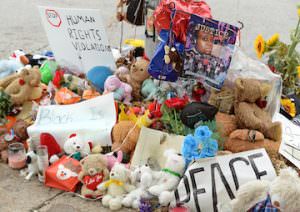 On Tuesday, four months after Michael Brown was shot and killed by Officer Darren Wilson in Ferguson, Mo., news broke that the Justice Department had released the results of its own autopsy.
 In the next few weeks, separate teams of doctors will issue autopsy reports about Michael Brown, the unarmed African-American shot to death by a police officer in Ferguson, Mo. If history is any guide, they will differ, perhaps significantly, on how to interpret the gunshot wounds on his body.
 As Missouri Gov. Jay Nixon ordered National Guard troops into Ferguson, a preliminary autopsy revealed that police shot teen Michael Brown six times. Amnesty International ordered a delegation to monitor developments, and a local pastor called for the police chief's resignation after department leaks muddied clarity of the lead-up to the teen's death.
You need to be a supporter to comment.
There are currently no responses to this article.
Be the first to respond.