Staff / TruthdigJun 5, 2016
Although the pontiff initially proposed a tribunal that would hold bishops accountable for protecting pedophile priests, he announced Saturday that he will instead clarify existing legal procedures. Although the pontiff initially proposed a tribunal that would hold bishops accountable for protecting pedophile priests, he announced Saturday that he will instead clarify existing legal procedures. Dig deeper ( 3 Min. Read )
Ruth Marcus / TruthdigJan 6, 2010
Much of the criticism of the Obama administration's decision to bring criminal charges against the failed Christmas Day bomber is ill-informed, ill-intentioned or both. All that said, I'm left with one nagging worry. Dig deeper ( 3 Min. Read )
Staff / TruthdigJan 21, 2009
President Obama has asked for a stay in all military tribunals at Guantanamo Bay while his administration figures out how to handle the legal cases of the detainees still held in the island prison. The move was welcomed by Human Rights Watch and the ACLU as a positive first step. Dig deeper ( 1 Min. Read )
Join our newsletterStay up to date with the latest from Truthdig. Join the Truthdig Newsletter for our latest publications.
Staff / TruthdigJul 18, 2008
In what will be the Pentagon's first war crimes trial since World War II, the U.S. will go forward Monday in trying Osama bin Laden's former driver, Salim Ahmed Hamdan. Unknown still is the trial date for Bush, Cheney, Rumsfeld, Wolfowitz and the rest of the government cabal that also may have committed war crimes. Dig deeper ( 1 Min. Read )
Staff / TruthdigJul 31, 2007
Kang Kek Ieu, otherwise known as Duch, the first of a group of former Khmer Rouge leaders to be investigated by a U.N.-affiliated tribunal in Cambodia, has been charged with crimes against humanity, according to the BBC. Dig deeper ( 1 Min. Read )
Staff / TruthdigJun 11, 2007
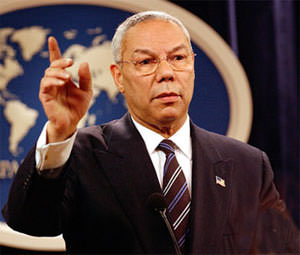
Colin Powell has come out against Guantanamo Bay: "Guantanamo has become a major, major problem in the way the world perceives America and if it were up to me I would close Guantanamo, not tomorrow but this afternoon" The former secretary of state has been eager to rehabilitate his image in recent years after a disastrous WMD sales pitch at the UN. Dig deeper ( 1 Min. Read )
Marie Cocco / TruthdigJun 8, 2007
Now we've bungled our own kangaroo courts. Two military judges, acting separately in the cases of two alleged terrorists, have dismissed war crimes charges against both. The legal reasoning is technical. But this breakdown is no technicality -- it is farce. Dig deeper ( 3 Min. Read )
Staff / TruthdigMay 17, 2007
A federal appeals court is looking into the legitimacy of "do-overs" for detainee tribunals at Guantanamo Bay. Critics say the practice is unfair because it effectively allows the government to retry cases until it gets the results it wants, but there may not be much the high court can do under current legislation. Dig deeper ( 1 Min. Read )
Marie Cocco / TruthdigApr 3, 2007
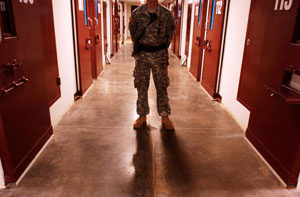
Like a terminally ill animal, the Guantanamo prison is soon to be put to death. It will be an ugly execution, played out against the sophomoric non sequiturs that are the unofficial soundtrack of the war on terror. Dig deeper ( 3 Min. Read )
Staff / TruthdigMar 30, 2007
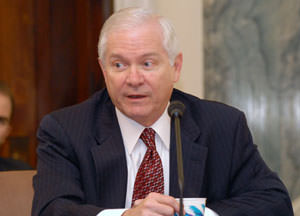
Robert Gates urged Congress on Thursday to close the Guantanamo Bay prison, acknowledging that the international community was likely to doubt the credibility of tribunals held there: "My own view is that because of things that happened earlier at Guantanamo there is a taint about it." Dig deeper ( 1 Min. Read )
Amy Goodman / TruthdigMar 28, 2007
David Hicks pleaded guilty Monday to supporting terrorism, probably to escape the living hell of Guantanamo Bay, with its show trials and "interrogation" chambers that continue to shame America at home and abroad. Dig deeper ( 3 Min. Read )
Staff / TruthdigMar 23, 2007
When the phrase "speaking on ground rules of anonymity" appears in The New York Times, we tend to get nervous, but a set of anonymous reports just caught our eye. According to those reports, our new defense secretary, right out of the gate (forgive the pun), argued for closing Guantanamo because its reputation had hurt the war effort. Robert M. Gates also reportedly argued that the detainees there should be brought to the U.S. Dig deeper ( 2 Min. Read )
Join our newsletterStay up to date with the latest from Truthdig. Join the Truthdig Newsletter for our latest publications.
Now you can personalize your Truthdig experience. To bookmark your favorite articles and follow your favorite authors, please login or create a user profile.
Now you can personalize your Truthdig experience. To bookmark your favorite articles and follow your favorite authors, upgrade to supporter.