|
|
|
|
|
|
|
|
|
|
|
|
|
|
|
|
|
|
By Robert Wright $17.15
$21
$35
|
|
|
|
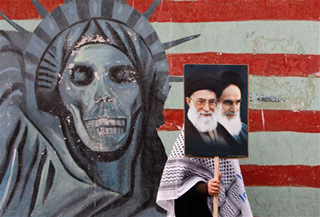
 AP / Vahid Salemi
|
By Robert Scheer — The supreme theocratic ruler of Iran is a dangerous madman never to be trusted with a nuclear weapon. How then to explain his recent seemingly logical and humane religious proclamations?
|
|
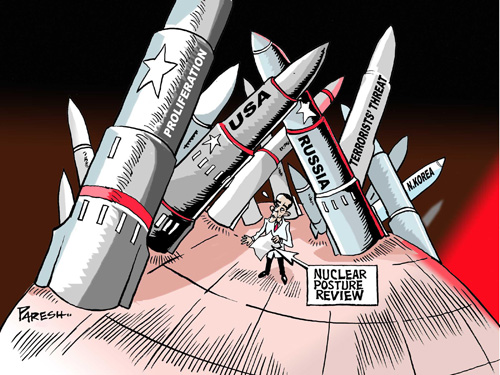
Paresh Nath, The Khaleej Times, UAE —
|
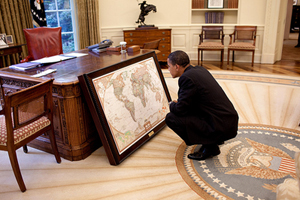
 White House / Pete Souza
|
By Scott Ritter — Fear of a nuclear Iran has generated irrational policies that will only hasten such an outcome. Instead of listening to his own words, the president fell for that old lure, a great power with great bombs that tells others what to do.
|
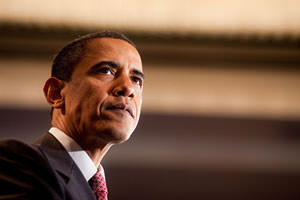
 White House / Pete Souza
|
The Nobel Committee has interrupted the president’s meditations on whether to escalate the war in Afghanistan by awarding him the Peace Prize. The committee cited Obama’s “extraordinary efforts to strengthen international diplomacy and cooperation between peoples” and especially his “vision of and work for a world without nuclear weapons.”
|
 news.bbc.co.uk
|
Following Thursday’s U.N. Security Council resolution aimed at halting nuclear proliferation, President Obama announced Friday that Iran has concealed a partly built second uranium enrichment plant. The Iranians admitted existence of the plant but asserted that it would be used only for peaceful purposes.
|
 AP / Ajit Kumar
|
A U.N. Security Council session led by President Obama has adopted a resolution calling for nuclear disarmament, focusing largely on measures aimed at halting weapons proliferation and lowering the risk of “nuclear terrorism.”
|
 U.S. Navy
|
Add this to the oft-forgotten list of things progressives can celebrate about the president: Obama’s decision to postpone the deployment of a missile shield in Eastern Europe has possibly averted a new arms race with Russia.
|
|
Petar Pismestrovic, Kleine Zeitung, Austria —
|
 Wikimedia Commons
|
John Isaacs, executive director of the Center for Arms Control and Non-Proliferation, joins the podcast with a status report on the spread of nuclear weapons. Cutting a deal with Iran and North Korea while getting the U.S. and Russia to downsize their own arsenals won’t be easy, but it may be only a matter of time—and diplomacy.
|
 U.S. Department of Energy
|
The founders of Global Zero, including Jimmy Carter, Mikhail Gorbachev and Sir Richard Branson, want to do for nuclear disarmament what Al Gore and other environmentalists did for climate change. While the vast majority of the world’s citizens seem to favor going nukeless, the issue has been confined to the back burner.
|
 Wikimedia Commons / Fastfission (altered)
|
A month too late for Halloween, a congressionally mandated independent panel has come to this terrifying conclusion: “Unless the world community acts decisively and with great urgency, it is more likely than not that a weapon of mass destruction will be used in a terrorist attack somewhere in the world by the end of 2013.” Boo!
|
|
By William Pfaff — The cynical view of national sovereignty holds that it belongs only to those who can defend it. This was said recently at the Pentagon concerning American manned and unmanned attacks inside Pakistan.
|
|
By Amy Goodman — Obama’s stated willingness to unilaterally strike nuclear-armed U.S. ally Pakistan, Clinton’s promise to Iran to “totally obliterate” the nation of 70 million (should it attack Israel), and McCain’s hard-line position on Russia, including the deployment of a missile defense in Eastern Europe, all point to a reliance on military solutions.
|
|
By Amy Goodman — Benazir Bhutto and her supporters who died with her during the suicide attack Dec. 27 are the latest victims of decades of dangerous U.S. support for Pakistan’s military regime.
|
 AP photo / B.K. Bangash
|
By Andrew Cockburn — A quartet of new books provides an inside look at Pakistan’s nuclear smuggling network and how it flourished. A sordid tale of how the United States simultaneously acted as an enabler for the construction of the “Islamic Bomb” and coddled the Islamists who might one day control it.
|
 AP photo / Sasa Kralj
|
By Reese Erlich — In this excerpt from his new book, “The Iran Agenda,” veteran independent journalist and Truthdig contributor Reese Erlich challenges the conventional wisdom on Iran’s nuclear ambitions as he investigates the drive for war.
|
 AP photos / Manuel Balce Ceneta / Adam Rountree / Lefteris Pitarakis
|
By Robert Scheer — Everybody seems to have a pick for president, or even a couple of picks. Problem is, neither Musharraf nor Bhutto nor Sharif stands up very well when the historical record is scrutinized.
|
 AP Photo / Ajit Kumar, File
|
By Scott Ritter — Scott Ritter, a former U.N. weapons inspector and the author of “Waging Peace,” mourns the passing of the United Nations agency charged with monitoring Iraq’s WMD program. That agency suffered a political assassination recently to save the Bush administration any lingering embarrassment. With the closure of UNMOVIC, Ritter writes, the world has lost perhaps its last best hope for meaningful arms control and inspection.
|
|
North Korea simply refuses to engage in the six-party talks until it receives $25 million in disputed funds. The disarmament deal struck by Washington and Pyongyang is now being held up by “technical problems.” U.S. negotiator Christopher Hill expressed his frustration: “The problem is, you can’t expect all these large delegations to sit around while it is being sorted out.”
|
 AP Photo / IRNA
|
By Tad Daley — There’s a clear lesson to be learned from George W. Bush’s “axis of evil” approach to foreign policy: Get a bomb or get invaded. The administration’s thinking can produce nothing but unprecedented nuclear proliferation.
|
 ucar.edu
|
For the first time in two decades, the United States will produce a new design of the hydrogen bomb. The weapon is meant to ease insecurities caused by the aging of America’s nuclear arsenal but probably will be a mortal blow to the administration’s credibility as it attempts to deter other countries from building nuclear weapons.
|
 washtimes.com
|
A top North Korean leader on Thursday reaffirmed his nation’s intention to disarm, calling a nuclear-free Korean peninsula the “dying wish” of former dictator Kim Il Sung. Kim Yong Nam, the North’s second-in-command, said his regime “will make efforts to realize” that wish.
|
 AP Photo / Greg Baker
|
By Robert Scheer — There is nothing wrong with negotiating with our enemies rather than weakly blustering at cartoon images of them—I wish we would do the same in our dealings with Iran—but it would be nice if we would stop shooting ourselves in the foot first.
|
 wikipedia.org
|
India and Pakistan have agreed to a deal meant to limit the possibility of inadvertent nuclear war. The two nuclear states have gone to war several times and frequently rattle sabers at each other.
|
|
Iranian President Mahmoud Ahmadinejad said Tuesday that his nation is willing to shut down its nuclear enrichment program in order to hold talks, but first the West must do likewise: “We say how is it that your [nuclear fuel] production facilities work 24 hours a day, but you feel threatened by our newly established complex and we need to shut it down for talks?”
|
|
The Bush administration hopes its deal with North Korea will serve as a “template” for Iran, but convincing Tehran to abandon its nuclear program won’t be a walk in the park. Unlike North Korea, Iran has no use for energy aid and has managed to outmaneuver the U.S. in several regional conflicts.
|
 ABC News
|
During a contentious interview with Diane Sawyer, Iranian President Mahmoud Ahmadinejad said that his country is “ready to cooperate” with regard to its nuclear program “within the framework of regulations.” He also called the Holocaust an “excuse” for the occupation of Palestinian land.
|
|
North Korea has agreed to shut down its main nuclear reactor within 60 days in exchange for either energy or economic aid. The U.S. has also promised to drop North Korea from a list of terrorist states and normalize relations.
|
|
The U.S. envoy to the six-party North Korea talks says all parties have reached tentative agreement on a deal, which would, according to previous reports, provide North Korea with energy assistance in exchange for an end to its nuclear program. A final text of the proposal has been distributed for review, and the delegates will meet again Tuesday to consider approving the agreement.
|
 from news.bbc.co.uk
|
The Russian president, normally a close ally of President Bush, used a security summit this week to lash out at American foreign policy, calling the U.S. “very dangerous.” Vladimir Putin added that the United States has “overstepped its borders” and is “nourishing” a nuclear arms race.
|
 AP Photo / Greg Baker
|
North Korea’s nuclear envoy announced on Thursday that his government is prepared to discuss nuclear disarmament, provided the United States softens its approach: “We are going to make a judgment based on whether the United States will give up its hostile policy and come out toward peaceful coexistence.”
|
|
A defiant Mahmoud Ahmadinejad said Sunday that U.N. sanctions would have no effect on his nation’s nuclear policy or economy: “The [U.N.] resolution was born dead and even if they issue 10 more of such resolutions it will not affect Iran’s economy and policies.”
|
 chasingmidnight.com
|
On Wednesday the “doomsday clock” ticked two minutes closer to midnight as the Bulletin of the Atomic Scientists assessed threats from nuclear proliferation and global warming. Meant to signify humanity’s proximity to a major global catastrophe, the clock is currently set to 11:55 p.m.
|
|
The U.S. and North Korea may meet for a second and possibly even a third round of talks following a surprise meeting. The White House had steadfastly refused to give in to Pyongyang’s desire for direct discussions outside of the six-party talks, but the recent rendezvous between the two countries suggests there may be more flexibility in Washington these days.
|
 nationalgeographic.com
|
The Sunday Times has learned that Israel is considering the use of tactical nuclear weapons in order to eliminate Iran’s nuclear program. According to Israeli military sources, the plan would be implemented only if the United States refused to act militarily or analysts decided a conventional attack would be unsuccessful. (h/t: Largest Minority)
|
 rottentomatoes.com
|
The Japanese daily Sankei says it has obtained an internal government report outlining the requirements for building a nuclear weapon. The Japanese government denies that it intends to build such a device. However, public pressure has mounted following North Korea’s nuclear and missile tests.
|
 news.bbc.co.uk
|
Iran responded defiantly Sunday to U.N. Security Council sanctions by announcing it would press ahead with nuclear enrichment. “Previously we said repeatedly that if the Westerners wanted to exploit the UN Security Council it will not only have no influence but make us more determined to pursue our nuclear goals even faster,” said Iran’s top nuclear negotiator.
|
 news.bbc.co.uk
|
North Korean and U.S. envoys met for a rare bilateral discussion on Monday in a sidebar to the six-party talks. Both sides stuck to their guns, with the U.S. saying its patience was running out, and North Korea maintaining it would not end its nuclear program until both American and U.N. sanctions are dropped.
Posted on Dec 19, 2006
READ MORE
|
 npr.org
|
At a time when the U.S. is desperate to contain nuclear programs in North Korea and Iran, President Bush has signed off on legislation that allows for nuclear trade with India, a nation that refuses to sign the Nuclear Non-Proliferation Treaty. The deal squares with this administration’s nuclear policy, which has been at its best inconsistent and at its worst catastrophically negligent.
|

|
This week Truthdig Editor Robert Scheer looks at Elbaradei’s nuclear prophecy, Iraq after US withdrawal and Stan Goff’s “Reflecting on Rumsfeld.”
|
|
Mohamed El Baradei cautioned on Monday that as many as 30 nations could rapidly develop nuclear weapons. The International Atomic Energy Agency chief warned that countries are “hedging their bets” by developing peaceful nuclear programs that could provide the necessary technology and material for weaponization.
|
 Left: forbes.com/Right: time.blogs.com
|
George W. Bush, retreating to familiar ground, has blamed the Clinton administration for North Korea’s nuclear arsenal. But the official who brokered the Clinton-era deal with North Korea called the idea “ludicrous,” and defended his efforts.
|
 xanga.com
|
North Korea’s evident test of a nuclear device speaks to a failure of diplomacy long in the making, but Democrats have justifiably laid much of the blame on Bush, whose Iraq fixation and disinterest in nonproliferation have proved disastrous.
|
View the most popular tags overall?
|
|